

America Is Freaking Out Over a $25,000 Bare-Bones Truck—Meanwhile, Toyota Sells the Same Thing for $13,000 Everywhere but the US
Two stripped-down trucks—Slate's EV and Toyota's Hilux Champ—share the same minimalist philosophy but exist on opposite sides of a regulatory divide. This is what their parallel stories reveal about tariffs, safety rules, and what Americans actually want to drive.
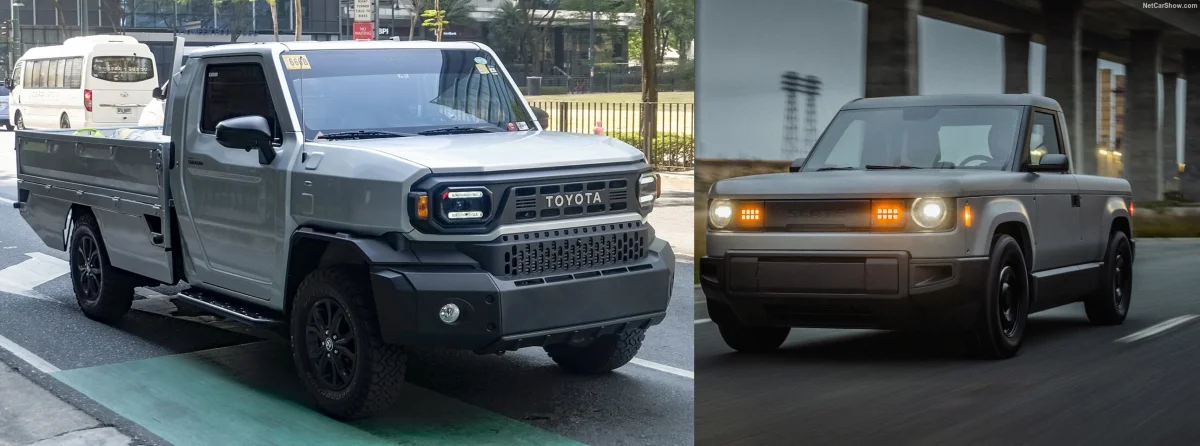
There is, quite frankly, an increasingly obvious truth about the American truck market: it has drifted so far from its utilitarian roots that a basic work truck now feels radical.
The average new car transaction price in the US hit $48,644 in early 2026. A Tesla Cybertruck starts at $80,000. Even the Ford F-150 Lightning kicked off at $57,000 before Ford pulled the plug.
Against that backdrop, two vehicles represent something genuinely different: the Slate, an American EV startup’s stripped-down electric pickup set to begin deliveries in late 2026, and Toyota’s IMV 0 (sold as the Hilux Champ), a $10,000-to-$13,000 gasoline/diesel workhorse that Toyota sells across more than 180 countries but deliberately keeps out of the United States.
An attentive study of both trucks, why they exist, and why one can’t legally be sold here reveals what the global auto industry actually values—and what it’s been selling Americans instead.
The Slate: Radical Simplicity, American Edition
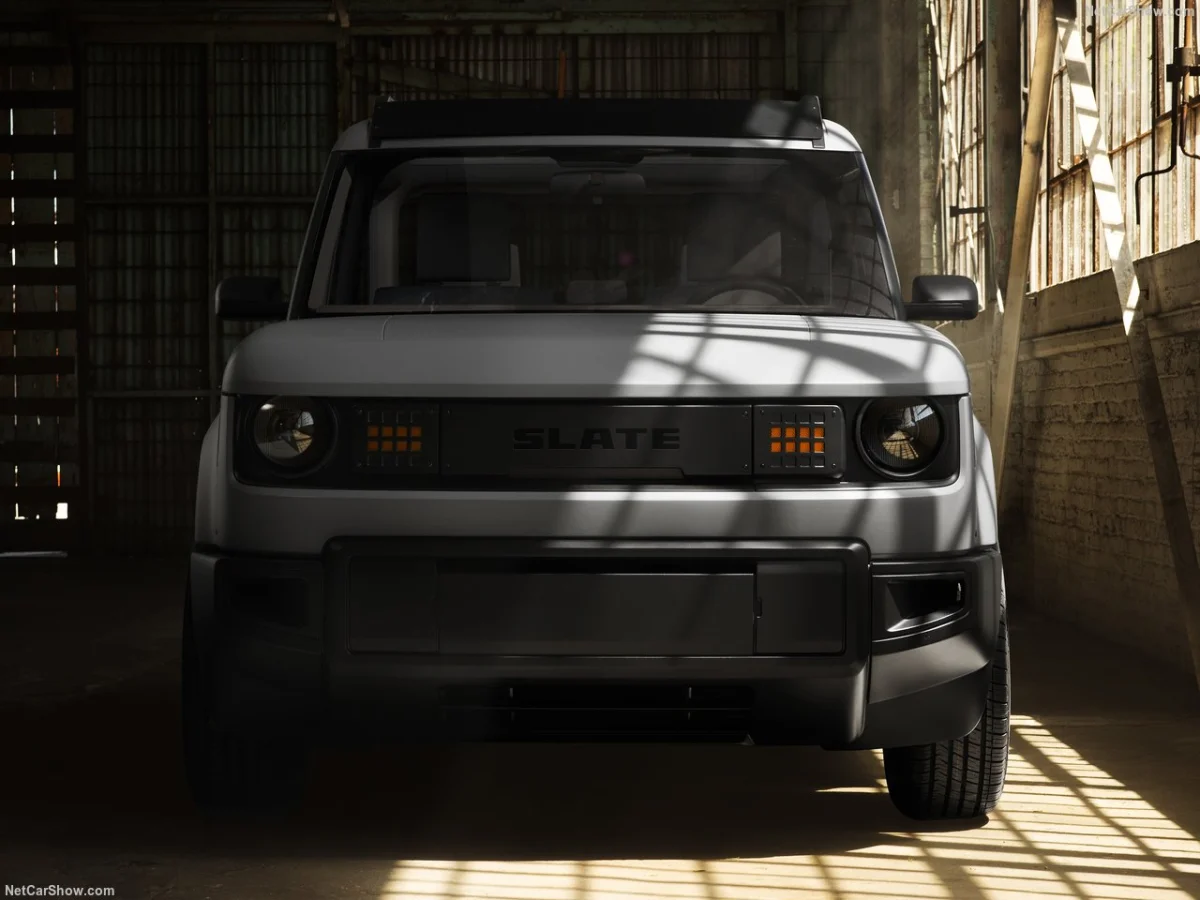
The Slate truck starts at $24,950, making it virtually the cheapest EV in the US and, by a significant margin, the most affordable new truck of any kind. That money buys something confrontationally bare. No touchscreen. No speakers. No power windows—you get a crank.
The body panels are unpainted gray polypropylene composite, a talc-reinforced plastic that dents and bounces back rather than cracking. It shrugs off everyday scrapes, stays corrosion-proof, and eliminates rust worries, though the utilitarian gray look is the truck’s most obvious feature—for better or worse.
Serious damage might complicate repairs, but overall durability and low maintenance win out, even if style and resale take a hit.
Every Slate rolls off the Warsaw, Indiana factory floor identical. Want color? Buy a vinyl wrap—full-vehicle wraps start under $500 with over 100 options. The engineering philosophy is rigorous: every component faced one question—“Does it need to be there?” Crank windows survived. NVH insulation had to fight for inclusion. Safety, however, was non-negotiable.
The base model includes traction control, electronic stability control, automatic emergency braking, pedestrian detection, forward collision warning, automatic high beams, a rearview camera, and up to eight airbags. Slate targets a five-star NCAP rating.
Under the polypropylene sits a 65-kWh lithium iron phosphate battery—chosen for longevity and thermal stability—driving a single rear-mounted motor with 181 horsepower and 195 lb-ft of torque.
Estimated range is 205 miles. Towing is 2,000 pounds; payload 1,550 pounds (competitive with the Maverick on payload, though well short of its 4,000-pound tow max). At 174.6 inches long, it’s a genuinely compact truck, shorter than the Maverick.
DC fast charging via NACS hits 20-80% in about 30 minutes at 120 kW. The 10-year/110,000-mile battery and powertrain warranty stands among the industry’s most aggressive at this price.
Suspension is old-school: MacPherson struts up front and a de Dion axle with coil springs out back. The de Dion choice keeps costs low while avoiding the unsprung weight penalty of a traditional solid axle, delivering predictable ride quality.
Modularity defines the Slate. It starts as a two-seat pickup, but kits convert it post-purchase to a five-seat SUV with either a squared-off Squareback or sloped Fastback roofline. Over 175 accessories launch with it, turning the truck into a true platform for personalization at a price point that historically offered none.
The Toyota IMV 0: The Dirt-Cheap Work Truck America Can’t Have
Toyota unveiled the IMV 0 concept in December 2022 on the Innovative International Multi-Purpose Vehicle platform shared with the legendary Hilux.
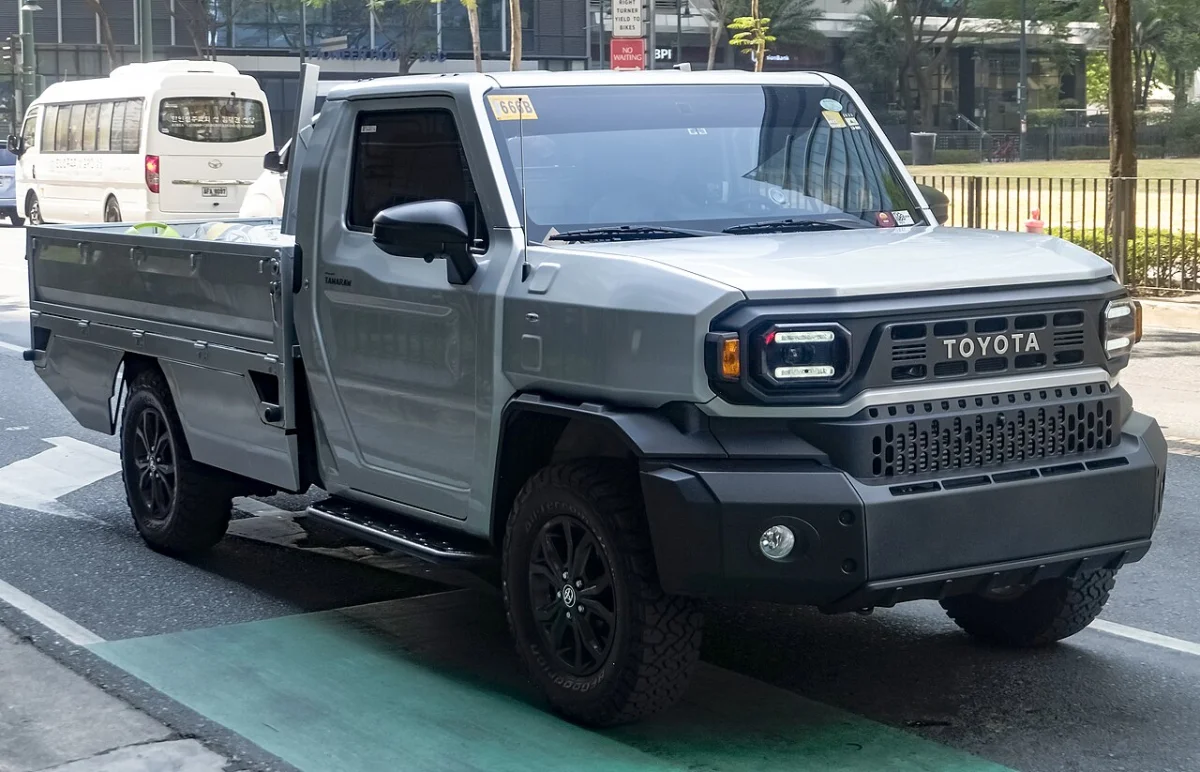
It launched in production as the Hilux Champ in 2023, priced around $10,000–$13,000. That buys a 2.0-liter inline-four gasoline engine with 137 hp mated to a 5-speed manual and a curb weight of about 3,248 pounds. Options include a 2.7-liter gas four-cylinder or 2.4-liter turbodiesel—choices tailored for high-mileage commercial users who prioritize torque and economy over headline power.
The interior is ultra-sparse: three HVAC knobs, no infotainment, no radio. Toyota calls its guiding philosophy “deliberate incompleteness.” The truck ships roughly 70% finished, leaving the remaining 30% for owners and small businesses to customize—delivery van, mobile shop, farm truck, overlander, you name it.
The bed, roof, and cab back are pre-drilled for accessories. Front fenders are bolt-on for easy swaps. The three-piece plastic bumper design makes repairs simple and cheap. Toyota even showed a disaster-relief variant with Red Cross branding.
Reviewers praise its confidence-inspiring drive. Thin A- and B-pillars deliver excellent visibility; manageable dimensions make tight maneuvering easy—unlike modern full-size trucks needing 360-degree cameras. It turns in a 16.1-foot radius thanks to a modified steering rack optimized for dense Southeast Asian traffic. Payload exceeds 2,000 pounds.
So why can’t Americans have it?
The Chicken Tax—a 25% tariff on imported light trucks since 1963—would slash the price advantage immediately. US safety and emissions standards are among the world’s strictest. The IMV 0 ships with just two airbags and lacks ADAS suites expected for favorable NHTSA ratings.
Emissions compliance would demand engine changes. Toyota’s chief engineer noted the “70% finished” design; the missing 30% are baseline requirements here. Even if cleared, a compliant, tariff-adjusted IMV 0 would likely price near the Tacoma, cannibalizing Toyota’s higher-margin products.
A Tale of Two Trucks, Compared Honestly
Both reject the American assumption that trucks must pack screens, luxury touches, and unasked-for features. Both embrace modularity as core, arrive deliberately incomplete to invite customization, and hit price points that feel disruptive today. Yet they diverge sharply.
The Slate is electric with 181 hp; the IMV 0 is combustion with a base 137 hp. Slate offers 205 miles of range and 30-minute charging; the IMV 0’s diesel stretches farther on a tank with three-minute refuels. Slate packs eight airbags and robust ADAS; the IMV 0 has two airbags and none. Slate chases five-star ratings; the IMV 0 skips them for target markets.
Use cases differ too. The Slate suits urban/suburban commuters, short-haul delivery, contractors with modest loads, and small farmers—its compact size and low EV running costs shine where infrastructure exists.
The IMV 0, built on the battle-tested Hilux platform, thrives on roads not on Google Maps. It’s fixable by local mechanics with basic parts, ideal for emerging economies. Its diesel delivers low-to-mid 30s mpg equivalent with dense fuel networks eliminating range anxiety.
Slate’s ownership math looks strong domestically with home charging, but charging gaps, longer-haul anxiety, and the absence of federal tax credits (post-2025 policy shifts) complicate it. The IMV 0’s mechanical simplicity promises lower maintenance and broader repair access—advantages anywhere, especially as owners keep vehicles longer.
What These Trucks Tell Us
Americans buzzing over a $25,000 American EV startup truck while a proven $13,000 Toyota exists globally highlights uncomfortable realities of US regulation, trade policy, and market structure.
The IMV 0 stays out not because it’s bad—it’s excellent for its purpose—but because the system can’t accommodate it. Tariffs protect domestics. Safety mandates, however well-intentioned, raise certification floors. Automakers avoid cannibalizing profitable lineups.
The Slate is America’s answer to a question Toyota solved elsewhere: more expensive, more complex, from a startup with 100,000 reservations but no deliveries yet. It’s what the market can actually produce and sell in 2026 under existing constraints.
Both trucks deliver the same message: people want fewer features and lower prices, not more of both. The disagreement lies in execution—and which side of a regulatory border you stand on. The Slate will test whether America truly hungers for cheaper, simpler vehicles.
This is an optimized version of the article originally published on Cars and Horsepower. Read the full article here: https://www.carsandhorsepower.com/featured/two-trucks-two-worlds-one-idea-the-slate-vs-the-toyota-imv-0.
What's Your Reaction?
 Like
0
Like
0
 Dislike
0
Dislike
0
 Love
0
Love
0
 Funny
0
Funny
0
 Wow
0
Wow
0
 Sad
0
Sad
0
 Angry
0
Angry
0

Cars and Horsepower is a dynamic automotive hub, focused on delivering news, reviews, and technical insights. It embraces industry trends and driving culture, blending deep engineering analysis with consumer guides. It's a comprehensive hub for enthusiasts and everyday drivers.







Comments (0)