

Unravelling Contemporary Africa through Innovation: Reimagining Education for Productive Transformation
Written By: Sir Alfred Kesse (The Pan-African Child) This article argues for a fundamental rethinking of African education, moving beyond certification towards innovation, knowledge production and productive transformation. It introduces the Productive Education Model as a pathway from knowledge and critical thinking to creativity, innovation, production and development.
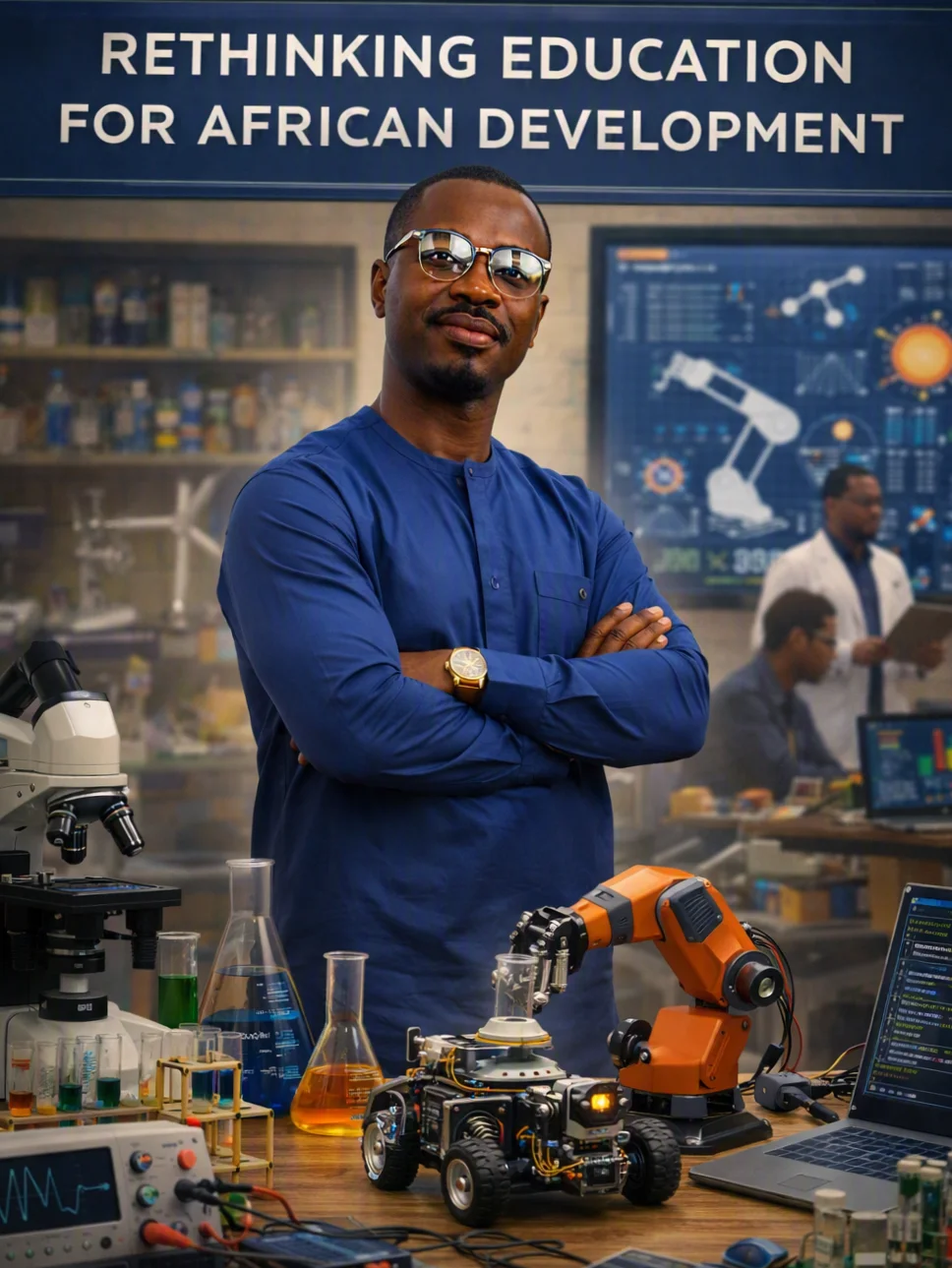
Africa's contemporary development trajectory is marked by a striking tension between expanding educational aspirations and persistent difficulties in translating knowledge Africa's contemporary development trajectory is marked by a striking tension between into broad-based productive transformation. Across the continent, education remains central to national development strategies, yet the relationship between schooling, knowledge production, innovation and economic transformation remains uneven. This tension has become increasingly significant as African societies confront rapidly changing demographic, technological and economic conditions. The African Union's Agenda 2063 explicitly places well-educated citizens, science, technology and innovation alongside transformed economies, industrialisation, manufacturing and agricultural productivity as interconnected components of the continent's developmental aspirations.
The urgency of this relationship is reinforced by the continuing challenges confronting African education systems. The 2025 Transforming Learning and Skills Development in Africa report, produced jointly by UNESCO, the African Union and UNICEF, acknowledges considerable progress in expanding educational access while identifying persistent weaknesses in learning outcomes, skills development, teaching capacity, technical and vocational education, higher education and the alignment of education with Africa's social and economic needs. The report consequently calls for education systems that are not only more inclusive but also more responsive to the changing demands of African societies and economies.
The question, therefore, is no longer simply whether Africa needs more education. The more fundamental question concerns what education is expected to produce and for what developmental purpose. Educational expansion is undoubtedly important, but increased enrolment, graduation and certification cannot by themselves guarantee productive transformation. An education system may expand considerably while continuing to produce limited capacity for technological innovation, industrial development, entrepreneurship, research and locally grounded problem-solving. The developmental significance of education must consequently be assessed not only through access and attainment but also through the capacities, knowledge and innovations that education enables individuals and societies to generate.
This distinction becomes particularly important within the contemporary African context because the continent's developmental challenges increasingly require forms of knowledge that can be translated into practical solutions. Problems relating to food security, agricultural productivity, energy, healthcare, manufacturing, infrastructure, environmental sustainability and digital transformation cannot be addressed adequately through the accumulation of theoretical knowledge alone. They require individuals and institutions capable of identifying problems, generating ideas, adapting existing knowledge, experimenting with alternatives and transforming knowledge into socially and economically valuable outcomes. The African Union itself places innovation, science and technology at the centre of its vision for socioeconomic transformation and identifies research infrastructure, technical competencies, entrepreneurship and innovation as mutually reinforcing conditions for an African knowledge economy.
Innovation, therefore, should not be understood narrowly as the possession or adoption of advanced technologies. Such an understanding risks reducing innovation to digitalisation while overlooking the broader intellectual and productive capacities through which societies transform their circumstances. Innovation encompasses the ability to generate new ideas, improve existing practices, adapt knowledge to particular contexts and develop solutions to problems. In the African educational context, this means creating learning environments in which students are not merely trained to reproduce established information but are encouraged to question, investigate, design, experiment, create and apply knowledge. The challenge is consequently pedagogical as much as technological.
Such a reorientation requires a reconsideration of the relationship between education and production. Conventional educational trajectories have frequently positioned formal qualifications as the principal evidence of educational success, with employment becoming the anticipated destination of schooling. Yet a development-oriented educational philosophy must ask whether education can do more than prepare individuals to enter existing employment structures. It must also cultivate the capacity to create enterprises, develop technologies, improve production systems, conduct research, solve community problems and generate new forms of economic and social value. In this sense, education becomes productive not simply when it produces employable graduates, but when it develops the intellectual, technical and creative capacities necessary for individuals and institutions to participate actively in transforming their societies.
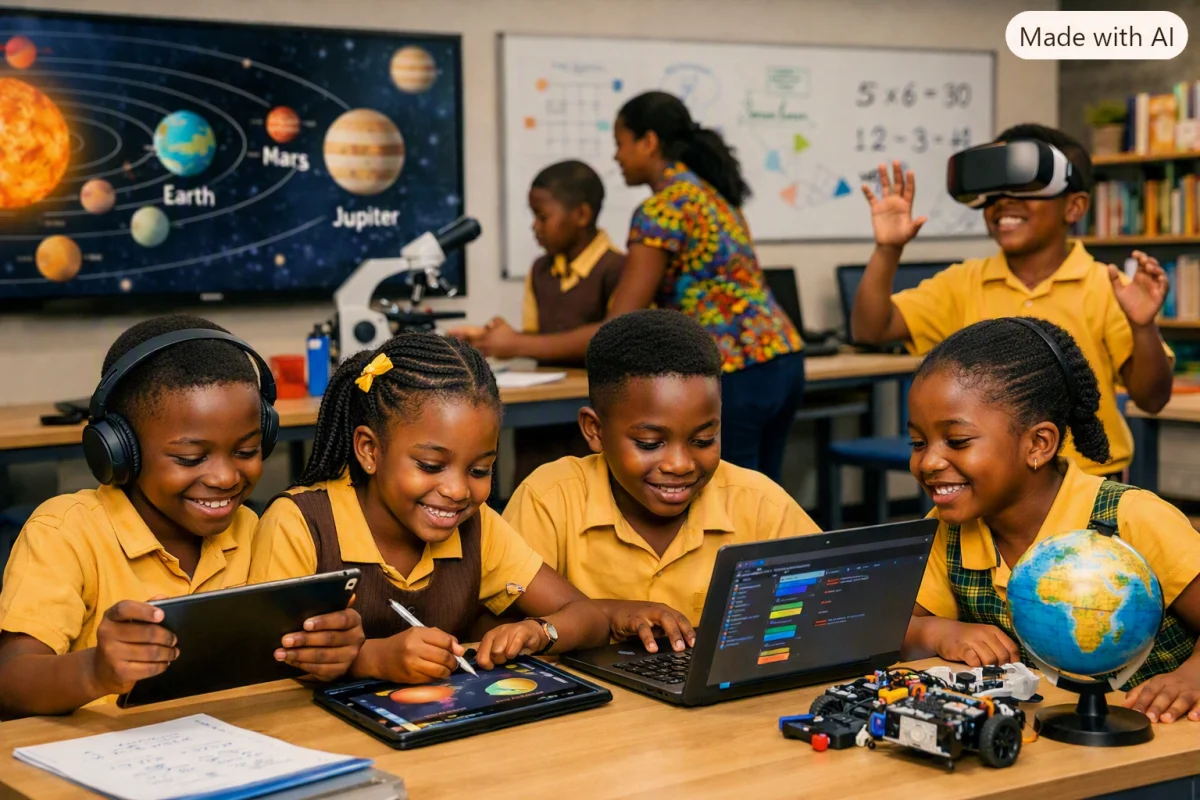
This argument resonates with continental policy thinking. The African Union's Continental Education Strategy for Africa seeks to reorient African education and training systems toward the knowledge, competencies, skills, innovation and creativity required for sustainable development. Its framework also emphasises stronger science and mathematics education, expanded technical and vocational education, stronger links between education and the world of work, and the revitalisation of tertiary education, research and innovation. More recently, the African Union's education agenda has continued to emphasise innovation, competency-based learning, digital transformation and the scaling of African-led educational innovations as part of the continent's 2025–2034 Decade of Education and Skills Development.
The convergence between education, innovation and development thus provides an important basis for rethinking the purpose of African education. However, policy recognition alone does not resolve the conceptual problem. What remains necessary is a deeper reconsideration of how education can be organised around productive transformation. Such a reconsideration requires moving beyond the assumption that development follows automatically from educational attainment. Rather, the relationship must be understood as mediated by the kind of knowledge education produces, the competencies it cultivates, the problems it encourages learners to address and the extent to which educational institutions are connected to productive, technological and social systems.
Against this background, this article argues that the transformation of contemporary Africa requires an innovation-centred reorientation of education from credential-oriented learning toward productive knowledge, creativity, problem-solving and knowledge production. It proposes that education should be understood not merely as preparation for participation in existing economic structures but as a mechanism through which individuals and institutions acquire the capacity to question, create, innovate and transform those structures. Productive transformation, in this sense, involves the conversion of knowledge and human capability into innovations, enterprises, technologies, productive practices and social solutions capable of addressing African developmental challenges.
The article therefore approaches innovation not as an isolated technological phenomenon but as an educational and developmental philosophy. It examines the limitations of an education model primarily oriented toward certification and employment, considers the role of innovation in transforming knowledge into productive capacity, and explores how African education can become more responsive to the continent's developmental priorities. It further advances a Productive Education Model in which knowledge, critical thinking, creativity and innovation are connected to production and, ultimately, economic and social transformation.
The article proceeds from the premise that Africa's educational challenge is consequently not reducible to a shortage of schools, graduates or qualifications. The deeper challenge concerns the relationship between what education teaches, what learners are able to do, and what societies are able to produce from the knowledge they possess. Reimagining this relationship is essential if education is to become a more powerful instrument of African transformation
Education occupies a central position in debates about Africa's developmental future because the capacity of societies to transform their economies, institutions and social conditions is closely connected to the knowledge and capabilities of their populations. Yet the developmental value of education cannot be measured adequately by the expansion of enrolment or the number of qualifications awarded. The more consequential question is whether education develops the intellectual, technical and creative capacities required to respond to the particular challenges confronting African societies. This distinction is increasingly important at a time when African development agendas place education, skills, science, technology and innovation within a common framework of structural transformation. The African Union's education strategy explicitly calls for education and training systems capable of developing the knowledge, competencies, skills, innovation and creativity required for sustainable development, while also emphasising stronger links between education, technical and vocational training, research and the world of work.
Historically, however, education in many African contexts has been shaped by purposes that have not always corresponded fully with the requirements of productive transformation. Colonial systems of schooling were introduced within political and economic structures that positioned African territories within wider imperial economies. While post-independence governments expanded educational opportunities and sought to use education as an instrument of nation-building, the inherited structures, curricula and institutional orientations were not completely displaced. The result has been a persistent tension between education as a means of individual advancement and education as an instrument of collective transformation. This tension does not imply that contemporary African education is simply a continuation of colonial education. Rather, it points to the need to examine critically whether existing educational structures have been sufficiently reconfigured to serve the developmental priorities of contemporary African societies.
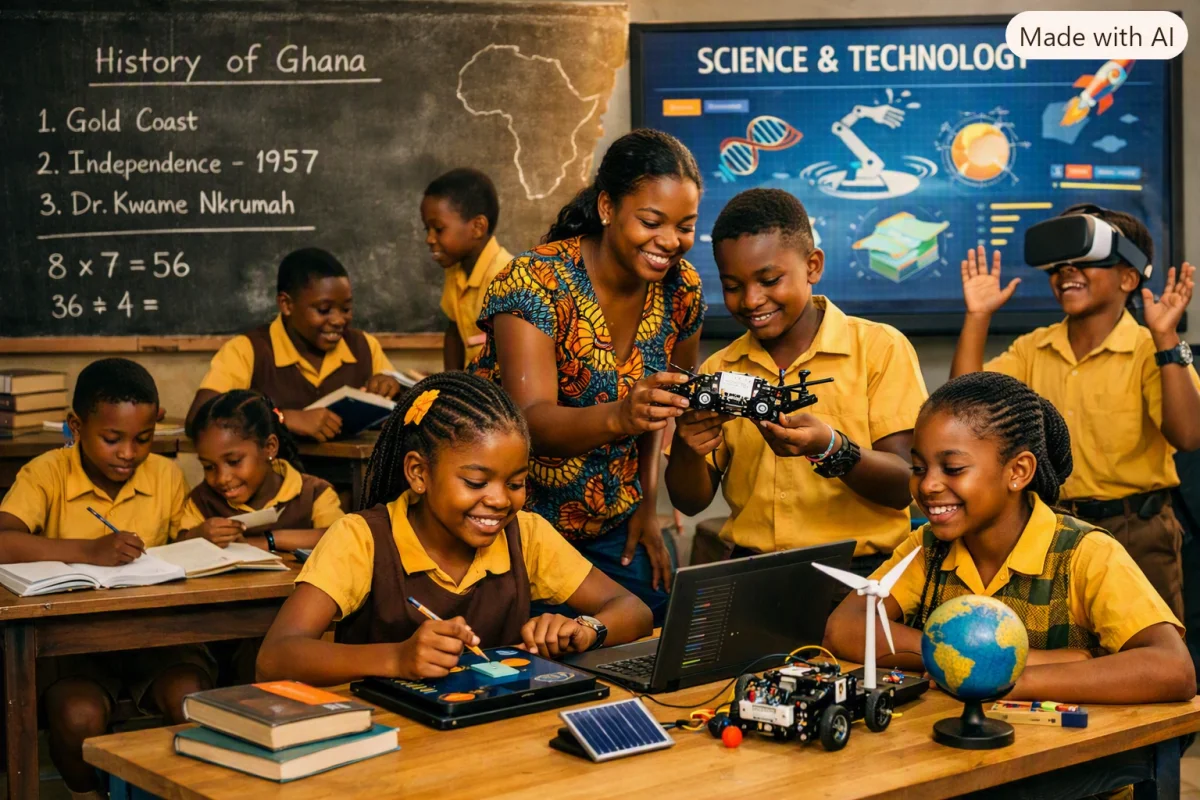
The distinction between education for individual advancement and education for productive transformation is particularly significant. Education necessarily contributes to individual mobility by providing knowledge, qualifications and opportunities. Nevertheless, when educational success becomes defined predominantly through examination performance, certification and access to formal employment, its broader developmental possibilities can become restricted. Such an orientation can encourage learners to perceive knowledge primarily as something to be acquired for personal advancement rather than as a resource for solving problems and generating social value. The issue, therefore, is not whether certificates or academic qualifications are valuable. They remain important. The question is whether qualification constitutes the endpoint of education or one stage in the development of capacities that can be applied beyond the classroom.
This distinction becomes clearer when education is considered within the broader concept of human capability. Development requires people who can interpret changing circumstances, make informed decisions, work with others, create new solutions and adapt knowledge to emerging problems. These capabilities cannot be reduced to the possession of information. They require forms of learning that connect knowledge with action. An education system designed for development must consequently cultivate not only what learners know but also what they are capable of doing with what they know. This shift from knowledge accumulation to knowledge application provides an important conceptual foundation for an innovation-oriented approach to African education.
The contemporary condition of African education makes this reconsideration particularly urgent. The second continental report on learning and skills development produced by UNESCO, UNICEF and the African Union notes that although educational access has expanded, significant challenges remain in learning outcomes, teacher capacity, technical and vocational education, higher education and the alignment of education and skills development with Africa's economic and social needs. These challenges reveal an important distinction between expanding an education system and transforming an education system. Expansion concerns the ability to bring more learners into education; transformation concerns what those learners experience, what capacities they acquire and how those capacities contribute to society.
The distinction is especially important because Africa's developmental pressures are increasingly complex. Rapid demographic change, technological transformation, climate pressures, food insecurity, infrastructure deficits and demands for industrialisation require forms of expertise that cross conventional disciplinary boundaries. A student who can reproduce information about agriculture, for example, is not necessarily equipped to improve agricultural productivity. Similarly, possessing theoretical knowledge of engineering does not automatically produce the capacity to design solutions suited to local infrastructural conditions. Development requires the movement of knowledge from classroom to application, application to innovation, and innovation to productive value.
This movement also challenges a narrow conception of the relationship between education and employment. Education is frequently evaluated according to its ability to make graduates employable, an objective that is undoubtedly important in societies experiencing high youth unemployment. However, employability represents only one dimension of educational contribution to development. An education system concerned with productive transformation must also cultivate the capacity to create enterprises, improve production processes, conduct research, develop technologies and identify opportunities within local communities. The African Union's current educational agenda reflects this broader understanding by connecting skills development with innovation, science and technology, entrepreneurship, research and structural transformation.
The significance of this shift is that it changes the question from “What occupation will education prepare this learner to enter?” to “What capacities will education give this learner to create value within society?” The latter question does not eliminate employment as an educational objective. Instead, it places employment within a broader ecosystem of production, enterprise, innovation and knowledge creation. A graduate may become an employee, entrepreneur, researcher, technician, farmer, engineer, teacher or inventor. What matters from the perspective of productive transformation is that education equips that individual with the capacity to contribute meaningfully to the development of society.
Such a perspective also requires a reconsideration of the relationship between education and African development policy. The African Union's continental education framework already recognises the need to strengthen science and mathematics education, expand technical and vocational opportunities, establish stronger connections between education and the world of work, and revitalise tertiary education, research and innovation. The more recent continental emphasis on scaling African-led educational innovations further indicates that innovation is increasingly being treated not simply as an outcome of education but as a mechanism through which education itself can be transformed.
The implication is that educational reform should not be approached solely as an exercise in improving access, infrastructure or examination outcomes, important as these remain. It should also involve a reconsideration of the purpose of learning. If education is to contribute to productive transformation, learners must encounter opportunities to investigate problems, test ideas, work collaboratively, design solutions and apply knowledge to real situations. Such an approach makes education more closely connected to the social and economic environments in which learners live.
This argument does not suggest that every learner must become an entrepreneur, scientist or inventor. Nor does it imply that theoretical or humanities-based knowledge lacks developmental value. Rather, it proposes a broader conception of productivity in which different forms of knowledge contribute to the capacity of societies to understand themselves, solve problems, create institutions and generate value. Innovation can emerge from engineering and technology, but it can also emerge from education, culture, governance, agriculture, communication, business and social organisation. Consequently, an innovation-centred educational philosophy should not narrow education into vocational training. It should broaden the purposes of learning by connecting intellectual development with creativity, application and social responsibility.
The fundamental issue, therefore, is not simply whether African education produces educated people, but whether it produces people and institutions capable of converting education into productive capacity. This is the point at which the question of innovation becomes unavoidable. If development depends partly upon a society's capacity to generate and apply new knowledge, then education must become one of the principal environments in which such capacity is cultivated. The challenge facing contemporary Africa is consequently to move beyond an understanding of education as the accumulation of qualifications and toward an understanding of education as a foundation for innovation, production and transformation.
This reconceptualisation provides the basis for the next stage of the argument. Before innovation can be positioned as a pathway to productive transformation, however, it is necessary to examine more closely the contradictions within contemporary African education itself. The following section therefore turns to the educational crisis not simply as a problem of access or quality, but as a question of relevance, orientation and developmental purpose.
- Innovation as a Catalyst for Productive Transformation
Innovation has increasingly become central to contemporary discussions of economic development, technological change and social transformation. Yet its significance within the African context requires a broader interpretation than one that equates innovation exclusively with technological advancement. Although digital technologies, scientific discoveries and technological inventions constitute important dimensions of innovation, innovation also involves the capacity to generate, adapt and apply knowledge in ways that produce new or improved solutions to existing problems. This broader understanding is particularly relevant to African development because many of the continent's most persistent challenges cannot be resolved simply through the importation of technologies developed elsewhere. They require the capacity to interpret local conditions, adapt knowledge to particular contexts and generate solutions that respond to African realities.
The developmental significance of innovation derives from its capacity to connect knowledge with transformation. Knowledge in itself does not automatically produce economic or social development. Its developmental value becomes more visible when it is translated into practices, processes, products, institutions and solutions that improve human conditions. Innovation therefore occupies an intermediary position between knowledge and productive transformation. It transforms what individuals and institutions know into what they are capable of creating or changing. In this sense, innovation can be understood as a process through which intellectual and creative capacities are converted into practical value.
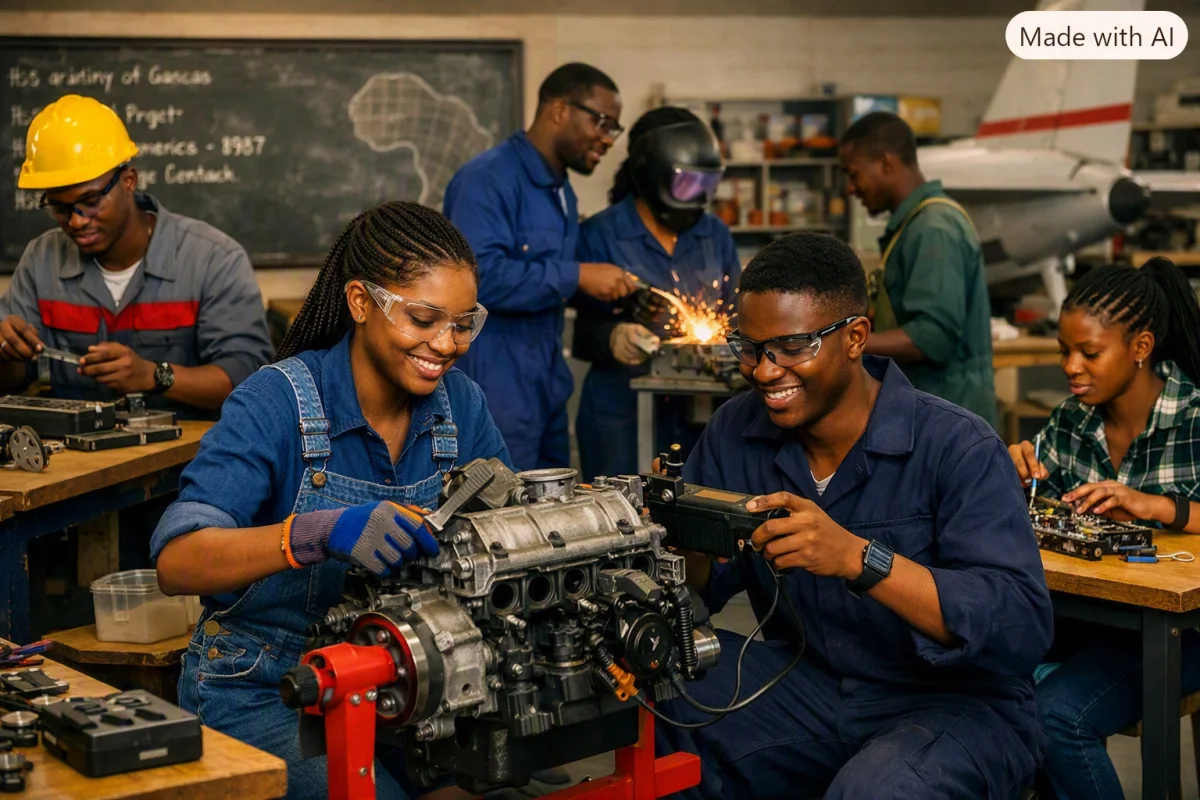
This distinction is important because development is not simply a consequence of possessing resources. Countries may possess substantial natural resources while continuing to depend on external expertise and imported technologies to extract, process and commercialise those resources. Similarly, societies may expand their educational systems without developing sufficient capacity to transform educational attainment into productive industries. The critical developmental question consequently concerns the ability to mobilise knowledge, skills and resources creatively. Innovation becomes significant precisely because it provides a mechanism through which these capacities can be combined to produce new forms of value.
The concept of innovation must therefore be distinguished from invention. An invention may represent the creation of something previously nonexistent, whereas innovation is concerned more broadly with the successful application, adaptation or improvement of ideas, processes or products. A society does not have to invent every technology it uses in order to become innovative. It must, however, develop the capacity to understand technologies, adapt them to local circumstances, improve them where necessary and integrate them productively into its economic and social systems. This distinction is particularly important for Africa because the continent's developmental trajectory cannot depend exclusively on the expectation that every solution must originate within Africa before it can be considered authentically African. Productive autonomy requires not isolation but capacity for adaptation, ownership and meaningful application.
Innovation is consequently inseparable from creativity, but the two concepts should not be treated as synonymous. Creativity concerns the generation of ideas, possibilities and alternative ways of thinking, whereas innovation involves the transformation of ideas into applications, processes or outcomes. Creativity provides the intellectual possibility; innovation gives that possibility practical expression. Education becomes significant within this relationship because it can either cultivate or constrain both capacities. An education system that rewards only the reproduction of established answers may provide learners with substantial information while offering limited opportunities to develop alternative approaches. Conversely, an education system that encourages questioning, investigation, experimentation and problem-solving creates conditions in which creative ideas can develop into innovative practices.
This relationship suggests that innovation should not be introduced into education as an additional subject alone. It should instead influence the philosophy of learning itself. If innovation is treated merely as a specialised activity reserved for students studying engineering, computer science or entrepreneurship, its developmental potential remains restricted. Innovation can emerge from multiple fields of human activity. A teacher can innovate in pedagogy; an agriculturalist can innovate in production; a health professional can develop more effective approaches to service delivery; an entrepreneur can create a new business model; an engineer can adapt infrastructure to local conditions; and a community can develop new institutional arrangements for addressing social challenges. Innovation is therefore not the exclusive property of laboratories or technology companies. It is a capacity that can be cultivated across society.
Such a conception of innovation is particularly relevant to the idea of productive transformation. Productive transformation involves more than economic growth in the narrow sense. It concerns the movement of an economy and society toward greater productive capacity, technological capability, diversification, value addition and improved living conditions. Innovation contributes to this process by enabling societies to improve how resources are used, how goods and services are produced and how social problems are addressed. The relationship can therefore be conceptualised as a progression:
Knowledge → Creativity → Innovation → Application → Production → Transformation.
Education occupies the foundation of this progression because it shapes the knowledge, habits of thought and competencies through which individuals engage with their environment. However, education alone is insufficient. Knowledge must encounter institutions, infrastructure, finance, markets and policies capable of supporting innovation. The educational system nevertheless remains one of the most important sites for cultivating the human capacities upon which an innovation ecosystem depends.
The African development context makes this particularly urgent. The continent possesses a young and rapidly growing population, expanding digital connectivity, increasing entrepreneurial activity and significant opportunities for economic diversification. At the same time, African economies continue to confront structural constraints relating to industrialisation, employment, productivity, technological capability and value addition. The challenge is therefore not simply to increase the number of educated people but to strengthen the relationship between education, innovation and productive systems. The African Union's Agenda 2063 explicitly identifies science, technology and innovation as important components of the continent's aspirations for socioeconomic transformation, while its education frameworks emphasise creativity, competencies, research, technical skills and innovation.
Innovation also provides a way of reconsidering the relationship between Africa and global knowledge. Development does not require African societies to operate independently of global scientific and technological networks. Such isolation would be neither realistic nor desirable. The challenge is instead to move from dependence on imported solutions toward greater capacity to participate in the production and adaptation of solutions. An African farmer using locally adapted agricultural technology, for instance, is participating in innovation even if the underlying scientific principle originated elsewhere. An African university adapting global knowledge to address a local health challenge is producing contextually relevant knowledge. An African manufacturer improving an imported production process to reduce costs or increase efficiency is engaging in innovation. These examples demonstrate that innovation is fundamentally concerned with capacity rather than geographical purity.
This capacity becomes particularly important when considering the relationship between innovation and natural resources. Africa's development has often been discussed in terms of its abundance of minerals, agricultural land, energy resources and other raw materials. Yet resource abundance does not necessarily translate into structural transformation. Greater developmental value can emerge when knowledge and innovation are used to move from the extraction of raw materials toward processing, manufacturing, value addition and technological development. Education therefore has a role to play in developing the engineers, scientists, technicians, entrepreneurs, researchers and skilled workers required to move economies further along productive value chains.
The same logic applies to agriculture. Agricultural transformation requires more than increased production of primary commodities. It involves innovations in irrigation, storage, processing, logistics, agricultural biotechnology, market access, financing and climate adaptation. Education can support these processes by enabling learners to understand agricultural systems scientifically while also developing the practical and entrepreneurial capacities necessary to improve them. Innovation consequently creates a bridge between educational knowledge and productive activity.
The relationship is equally evident in manufacturing and digital transformation. Manufacturing requires technical knowledge, engineering competence, research capacity and continuous improvement. Digital economies require programmers, designers, data specialists, entrepreneurs, researchers and users capable of adapting digital tools to local needs. Neither sector can be sustained through consumption alone. Digital platforms, technologies and manufactured products may be imported, but sustainable development requires domestic capacity to adapt, maintain, improve and eventually create them. This is why innovation must be considered not merely an economic outcome but a capacity for economic agency.
The educational implications are substantial. If innovation depends upon the ability to identify problems, generate possibilities and implement solutions, then education must create opportunities for learners to encounter authentic problems. The classroom should therefore become more than a space in which established knowledge is transmitted. It should become a space in which knowledge is tested, questioned, applied and extended. Students should be encouraged to investigate the conditions surrounding them and to consider how existing knowledge might be used differently. Such an approach does not diminish academic rigour. Rather, it gives academic knowledge a more active developmental function.
This also requires a reconsideration of failure within educational practice. Innovation necessarily involves experimentation, uncertainty and revision. A learner who is never permitted to make mistakes may become highly cautious about proposing unfamiliar ideas. An educational environment that treats every incorrect answer simply as failure can unintentionally discourage intellectual risk-taking. Innovation-oriented education should instead distinguish between careless error and productive experimentation. Learners should be encouraged to test ideas, evaluate outcomes and revise their approaches. In this sense, education becomes a rehearsal for the uncertainty inherent in research, entrepreneurship and problem-solving.
At the same time, innovation must remain connected to ethical and social responsibility. Not every new idea constitutes beneficial innovation. Technologies can create new inequalities, economic activities can produce environmental harm, and innovations can serve narrow interests rather than collective wellbeing. An African innovation agenda must therefore ask not only whether something is new but also whether it addresses meaningful problems, expands productive capacity, improves human welfare and contributes to sustainable development. Education has an important role in cultivating this ethical dimension because innovation without critical judgment can reproduce the very problems it seeks to solve.
The concept of innovation developed here therefore extends beyond technological novelty. It refers to a broader capacity to think differently, adapt knowledge, solve problems, create value and transform existing conditions. This broader conception makes innovation particularly relevant to African education because it connects intellectual development with productive agency. It also allows innovation to become a principle through which education can be reorganised rather than merely another objective added to an already crowded curriculum.
The central proposition is consequently that Africa's developmental future depends partly upon its capacity to convert educational knowledge into innovative and productive capability. The challenge is not simply to produce learners who know more, but learners who can do more with what they know. It is not simply to increase the number of graduates, but to strengthen the capacity of graduates and institutions to create, adapt and apply knowledge. It is not simply to import technological solutions, but to develop the intellectual and institutional capacity to modify, improve and eventually generate solutions suited to African contexts.
This reconceptualisation leads directly to the next question: if innovation is to become a catalyst for productive transformation, how must African education itself be redesigned? It is insufficient to demand creativity and innovation from learners while maintaining curricula, teaching practices and assessment systems that reward conformity and reproduction. The educational structures that cultivate innovation must therefore be reconsidered. The next section turns to this question by examining how curriculum, pedagogy, assessment, teacher preparation, technical education and higher education can be reimagined around innovation and productive transformation.
- Reimagining Education for Innovation
If innovation is to function as a catalyst for productive transformation, it cannot be treated as an external addition to education. It must become part of the underlying philosophy through which knowledge is taught, acquired and applied. This requires a shift from an educational model that places primary emphasis on the transmission and reproduction of established knowledge toward one that cultivates the capacity to interrogate knowledge, generate ideas and apply learning to practical problems. The objective is not to replace foundational knowledge with creativity, nor academic disciplines with vocational training. Rather, it is to establish a more productive relationship between knowledge, critical thinking, creativity, application and innovation.
Such a reorientation begins with the curriculum. Curriculum determines, to a significant extent, what societies consider important enough for learners to know and what forms of knowledge are legitimised within educational institutions. An innovation-oriented curriculum must therefore move beyond the accumulation of disconnected information and create stronger relationships between disciplinary knowledge and real-world problems. Mathematics, science, languages, social sciences, humanities, technology and vocational subjects should not exist as isolated domains of knowledge with little connection to the environments in which learners live. Their developmental value increases when learners can recognise how knowledge from different fields can be combined to understand and address complex problems.
This requires a curriculum that gives greater attention to problem-solving and application. Learners should encounter questions for which knowledge is not simply an answer already contained in a textbook but a resource through which an answer can be constructed. Such an approach changes the learner's relationship with knowledge. Instead of asking only, “What is the correct answer?”, the learner is encouraged to ask, “Why does this problem exist?”, “What evidence explains it?”, “What alternatives are possible?” and “How can this knowledge be applied to improve the situation?” These questions cultivate habits of inquiry that are essential to innovation.
The transformation of curriculum must also involve a reconsideration of local relevance. African education cannot become innovation-oriented if learners are consistently encouraged to perceive the most significant problems as problems occurring elsewhere. The immediate social and economic environment provides an important laboratory for learning. Issues such as agricultural productivity, waste management, water access, energy, transportation, housing, healthcare, environmental sustainability and digital inclusion can become sites of educational inquiry. Connecting curriculum to such problems does not mean reducing education to immediate utility. Instead, it demonstrates how abstract knowledge can acquire practical significance when applied to real conditions.
Pedagogy is equally important. A curriculum designed to cultivate innovation can remain ineffective if teaching continues to position the teacher as the sole authority and the learner primarily as a passive recipient. Innovation requires active intellectual participation. Learners need opportunities to investigate, discuss, question, experiment, collaborate and defend ideas. This does not eliminate the teacher's authority or expertise. Rather, it changes the teacher's role from being principally a transmitter of information to becoming a facilitator of inquiry and a designer of meaningful learning experiences.
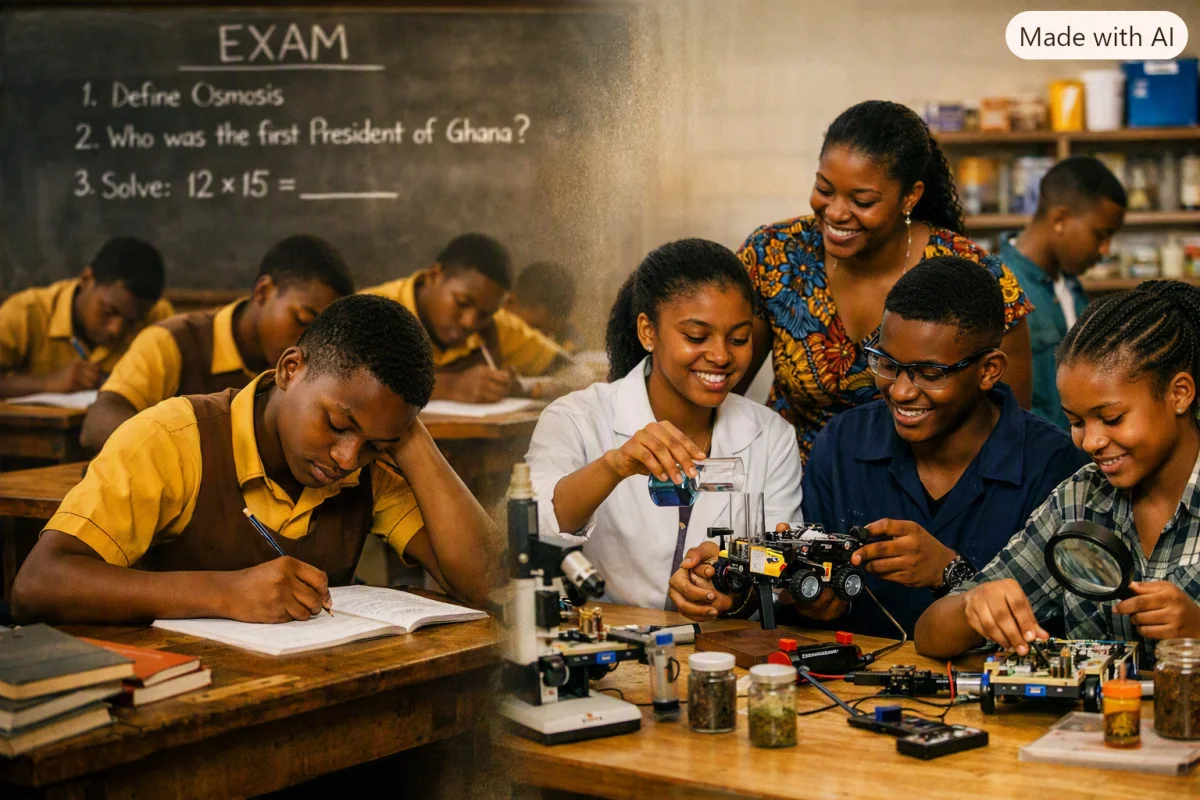
The implications for classroom practice are considerable. A lesson on environmental science, for example, can move beyond definitions of pollution toward an investigation of waste within the learners' own community. A mathematics lesson can involve analysing local economic data rather than limiting mathematical competence to abstract exercises. A business lesson can require learners to identify an unmet need and develop a responsible response to it. A language lesson can involve research, communication and public presentation around a social issue. Through such approaches, different subjects retain their disciplinary integrity while contributing to a common educational objective: the capacity to use knowledge meaningfully.
Such pedagogy also requires a more productive understanding of questioning. In conventional classrooms, questions may be used primarily to determine whether learners remember what has already been taught. In an innovation-oriented classroom, questions can also become instruments for generating knowledge. Learners should encounter open-ended problems in which multiple approaches may be possible. The capacity to formulate a good question becomes almost as important as the ability to provide an answer. This is particularly relevant because innovation frequently begins not with a solution but with the recognition that an existing situation can be approached differently.
Assessment represents another major area requiring transformation. Examination systems inevitably influence what students consider worth learning. If assessment rewards mainly memorisation and the reproduction of predetermined responses, learners and teachers have strong incentives to prioritise those activities. An education system that seeks to cultivate innovation must therefore broaden its conception of achievement. Knowledge remains essential, but assessment should increasingly consider application, reasoning, creativity, research, communication, collaboration and problem-solving.
This does not mean abandoning examinations. Standardised assessment can provide valuable information about learning and ensure that foundational competencies are acquired. The issue is balance. A learner who can reproduce a scientific principle but cannot apply it to a practical problem demonstrates a different level of competence from one who understands the principle and can use it creatively. An innovation-oriented assessment system should be capable of recognising this difference.
Project-based learning, research assignments, practical demonstrations, prototypes, portfolios and community-based projects can therefore complement conventional examinations. Such approaches allow learners to demonstrate what they can do with knowledge, rather than only what they can remember. They also create opportunities for learners to experience the iterative nature of innovation, in which an initial idea may require testing, modification and improvement before becoming effective.
Teacher preparation must evolve alongside these changes. It is unrealistic to demand innovative learning from teachers who have themselves been prepared primarily within systems of transmission and examination. Teachers require opportunities to develop their own capacities for inquiry, experimentation and reflective practice. Professional development should therefore move beyond occasional workshops focused on administrative requirements and provide sustained opportunities for teachers to investigate pedagogical problems, collaborate with colleagues, use technology appropriately and design new learning experiences.
The teacher's role is particularly important because innovation-oriented education does not mean removing structure from learning. Creativity requires knowledge, discipline and guidance. Teachers must therefore know when to provide direct instruction and when to allow learners to investigate independently. The objective is not a classroom in which students simply “do whatever they want,” but one in which learners receive sufficient intellectual structure to explore meaningful questions and sufficient autonomy to develop their own solutions.
Technical and vocational education also requires a fundamental reconsideration within this framework. For productive transformation to occur, societies require individuals capable of designing, building, repairing, operating and improving physical and technological systems. Yet technical and vocational pathways have often been treated as alternatives for learners who are perceived as less academically successful. Such a hierarchy is incompatible with an innovation-oriented development strategy. Productive economies require diverse forms of expertise, and technical competence is not inferior to academic knowledge. Indeed, technological innovation often depends upon the interaction between theoretical understanding and practical expertise.
The challenge, therefore, is to establish stronger relationships between academic, technical and vocational knowledge. Engineering requires mathematics and physics but also practical experimentation. Modern agriculture requires biological knowledge but also technical competence and entrepreneurial understanding. Digital technology requires theoretical computing knowledge but also design, communication and problem-solving skills. Productive transformation occurs when these forms of knowledge interact rather than when they are artificially separated.
Higher education represents another critical site of transformation. Universities occupy a distinctive position because they can connect advanced learning with research and innovation. If universities are to contribute more directly to African development, they must strengthen the relationship between teaching, research, industry and society. Students should encounter opportunities to participate in research and innovation rather than experiencing research only as an activity reserved for postgraduate study. Undergraduate education can introduce students to inquiry, data collection, experimentation, design and critical evaluation, thereby establishing the foundations for future knowledge production.
Universities must also become more responsive to the developmental problems surrounding them. Research agendas should not be determined exclusively by external academic incentives while local problems remain insufficiently investigated. African universities possess considerable intellectual resources, but their developmental contribution depends partly upon their capacity to connect research with national and continental priorities. Partnerships with industry, government, communities and civil society can help create pathways through which research moves from academic publication toward practical application.
This requires, however, a careful understanding of the relationship between innovation and indigenous knowledge. An innovation-oriented African education system should not assume that innovation begins only when knowledge is introduced from technologically advanced societies. African communities have long developed adaptive practices in agriculture, architecture, medicine, environmental management, craft production and social organisation. Such knowledge should not be romanticised or treated as automatically scientifically valid. It should instead be investigated critically, documented where appropriate, tested against evidence and integrated with contemporary scientific knowledge where useful. The objective is to establish a dialogue between knowledge traditions rather than a hierarchy in which one is automatically dismissed and another automatically accepted.
Digital technology presents another opportunity, but it should be approached as an instrument rather than the definition of innovation. Digital tools can expand access to information, support collaboration, facilitate simulations and enable new forms of learning. Artificial intelligence and other emerging technologies may further transform education. Yet providing students with devices does not automatically create innovative learners. Technology becomes educationally transformative when it enables learners to investigate, create, analyse, communicate and solve problems more effectively. The question should therefore not simply be whether African schools are becoming more digital, but whether digital transformation is producing greater intellectual and productive capacity.
An innovation-centred educational system must consequently develop a culture in which curiosity is valued. Curiosity is the impulse to ask why existing conditions are the way they are and whether they can be changed. When learners are encouraged to question assumptions respectfully and investigate alternatives, education becomes a space of possibility. When questioning is discouraged and conformity becomes the principal measure of good learning, the possibilities for innovation are narrowed.
This cultural dimension is particularly important because innovation cannot be produced through curriculum reform alone. It depends upon the broader institutional culture of education. Schools and universities must be willing to experiment with new approaches, evaluate their results and revise them when necessary. Educational institutions themselves must become learning organisations. They cannot demand adaptability from students while remaining resistant to change in their own practices.
Reimagining education for innovation therefore requires transformation at several interconnected levels:
Curriculum must connect knowledge with meaningful problems.
Pedagogy must cultivate inquiry, creativity and active participation.
Assessment must recognise application and problem-solving alongside foundational knowledge.
Teacher education must prepare educators to facilitate innovative learning.
Technical and vocational education must be repositioned as a central component of productive development.
Higher education must strengthen its role in research, knowledge production and innovation.
Technology must support learning and creation rather than simply provide digital consumption.
Local knowledge must enter into critical dialogue with global scientific knowledge.
Taken together, these changes point toward a fundamental shift in the purpose of education. The learner should no longer be conceptualised principally as the final recipient of an established body of knowledge. The learner should also be understood as a potential producer, adapter, investigator, creator and problem-solver. Such a transformation does not diminish the importance of teachers, textbooks, examinations or established academic disciplines. It places them within a broader educational purpose in which knowledge becomes a foundation for action and innovation.
The ultimate objective is therefore not to turn every African learner into an inventor or entrepreneur. It is to develop a population with the intellectual and practical capacity to engage creatively with changing circumstances. Some learners will become researchers; others teachers, engineers, farmers, artists, health professionals, technicians, entrepreneurs, public servants or workers in emerging industries. What connects these diverse pathways is the capacity to think critically, apply knowledge, adapt to change and contribute to the creation of value.
This is the educational foundation upon which productive transformation depends. Yet educational innovation cannot achieve its full developmental potential if African societies remain predominantly dependent upon externally generated knowledge and technological solutions. The transformation of education must therefore be accompanied by a transformation in Africa's relationship with knowledge itself. The next section examines this issue by considering how African education can contribute to a transition from knowledge consumption to knowledge production.
- From Knowledge Consumers to Knowledge Producers
The transformation of an educational system cannot be measured adequately by the number of learners who pass through it. A more consequential question concerns what learners, institutions, and societies are able to do with the knowledge they acquire. Education becomes developmentally significant when knowledge moves beyond examination halls and academic publications to influence how problems are understood, technologies are developed, resources are managed, and productive activities are organised. For contemporary Africa, this requires a shift from a predominantly knowledge-consuming orientation towards a stronger culture of knowledge production.
Knowledge consumption is not inherently problematic. No society can develop by rejecting knowledge generated elsewhere. Scientific advancement itself depends on cumulative knowledge, international exchange and intellectual cooperation. The problem arises when the relationship between African societies and global knowledge remains largely one-directional, with Africa primarily positioned as a recipient, adopter or user of ideas generated elsewhere. Such a position can limit the continent's capacity to define its own research priorities, develop context-specific solutions and exercise intellectual ownership over knowledge relevant to its development.
Recent UNESCO analysis identifies the global research landscape as geographically imbalanced and notes that African contributions remain significantly underrepresented. UNESCO reports that Africa generates only about 1% of global scientific research and that research and development investment remains substantially below the global average. At the same time, UNESCO cautions that conventional measures of knowledge production do not adequately capture Indigenous and local knowledge systems. The issue, therefore, is not simply that Africa lacks knowledge. Rather, the continent faces a structural challenge in converting its intellectual resources, research capacity, local experience and scientific potential into recognised, sustained and productive knowledge systems.
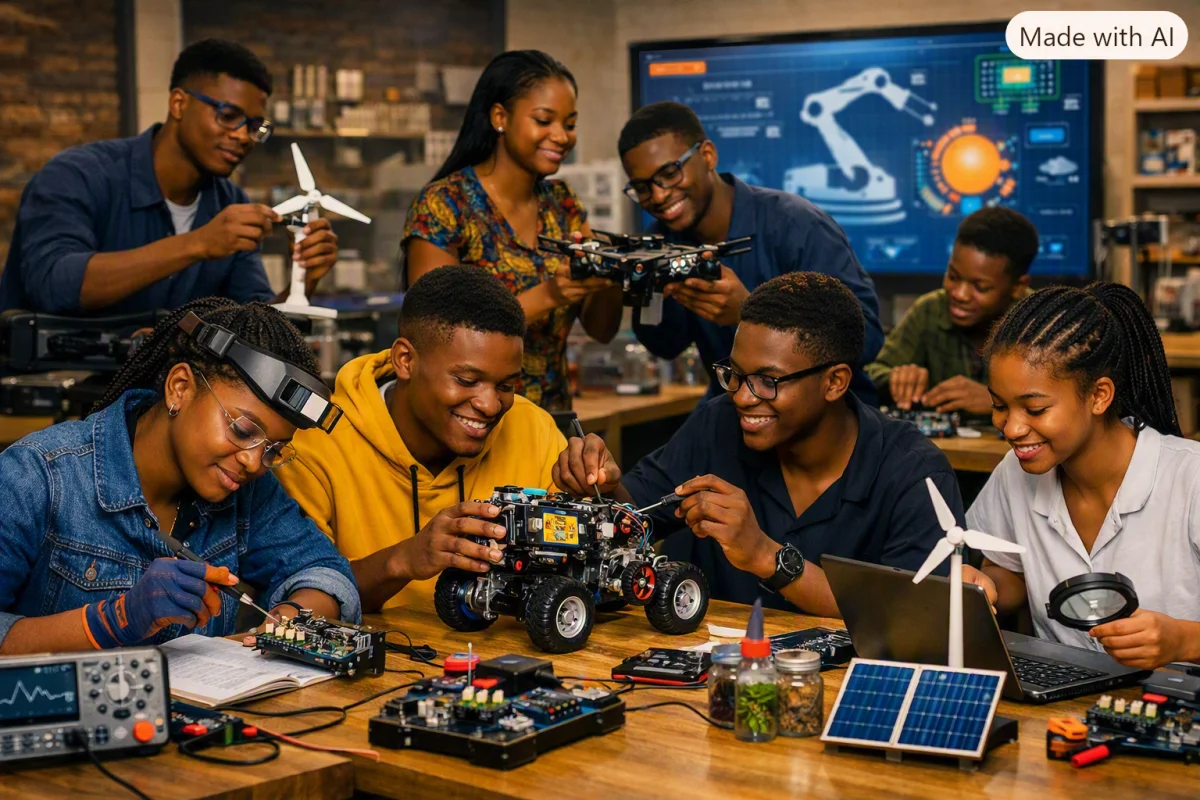
This distinction is important because knowledge production involves more than publishing academic work. It includes the ability to formulate questions, investigate problems, generate evidence, develop theories, create technologies, improve existing processes, document local practices and translate findings into social and economic applications. A university that produces graduates without cultivating these capacities may contribute to the expansion of education without necessarily strengthening the productive knowledge base of society. Conversely, a university that encourages students and researchers to investigate local problems can become an important institution of national and continental transformation.
The African Union's educational and science, technology and innovation frameworks increasingly recognise this relationship. Its education agenda calls for the revitalisation of tertiary education, research and innovation to address continental challenges, while its science and technology strategy places innovation at the centre of Africa's socioeconomic development. The AU also identifies research infrastructure, professional and technical competencies, entrepreneurship and innovation, and an enabling environment as mutually reinforcing conditions for an innovation-led, knowledge-based economy. These priorities suggest that education should not terminate with the acquisition of knowledge. It should create institutional and intellectual conditions through which knowledge can be continually questioned, expanded and applied.
Knowledge production and African intellectual agency
The movement towards knowledge production is also a question of intellectual agency. A society exercises intellectual agency when it possesses the capacity to define important questions about its own circumstances and to participate meaningfully in determining how those questions are investigated and answered. This does not require intellectual isolation. On the contrary, African scholars and institutions must participate actively in global scientific conversations. The objective is to enter those conversations not merely as consumers of established theories and technologies but as contributors capable of generating concepts, evidence and solutions.
This requires a reconsideration of what counts as a legitimate research problem. African research should not be restricted to questions that attract external funding or reproduce established international research agendas. Universities and research institutions should also be encouraged to investigate problems emerging from African realities. These may include food insecurity, agricultural productivity, public health, water management, urbanisation, energy access, environmental degradation, digital inclusion, housing, transportation, manufacturing and the development of local industries. Such problems are not intellectually inferior because they are local. They are precisely the kinds of problems from which new knowledge and innovation can emerge.
UNESCO's recent work on transforming knowledge in Africa similarly calls for research systems that are more responsive to local realities and more inclusive of Indigenous and community-based forms of knowledge. It emphasises the need to strengthen African research ecosystems, improve research infrastructure and training, promote interdisciplinary collaboration, and develop more equitable forms of international research partnership. The significance of this position lies in its rejection of a narrow understanding of knowledge. African development requires scientific knowledge, but it also requires knowledge that is historically grounded, socially relevant and capable of engaging the realities within which development takes place.
The recognition of Indigenous knowledge is particularly important in this regard, although it should not be romanticised. Indigenous knowledge should neither be accepted uncritically nor dismissed because it does not originate within formal academic institutions. Its value should be examined through systematic documentation, testing, comparison and dialogue with other knowledge systems. Agricultural practices, ecological knowledge, traditional construction methods, medicinal knowledge, conflict-resolution practices and community-based resource management can provide important starting points for research and innovation. When educational institutions investigate such knowledge critically, they transform learners from passive recipients into researchers who ask how existing knowledge can be understood, improved and applied.
This approach also challenges the assumption that innovation necessarily means importing something technologically advanced from outside Africa. Innovation can involve adapting an existing technology to a local environment, combining different forms of knowledge, improving a production process, reducing costs, developing a new service or solving a problem through locally available resources. The capacity to adapt and improve is itself a form of knowledge production.
Universities as engines of knowledge and innovation
Higher education occupies a particularly important position in this transformation because universities sit at the intersection of knowledge, research, professional preparation and social development. Yet the expansion of tertiary education creates little developmental value if institutions remain primarily oriented towards certification. UNESCO reports that only about 9% of Africa's population has access to higher education, substantially below the global average, while also identifying weak research capacity and the disconnect between academic study, applied research and development needs as continuing challenges.
The university of the future in Africa therefore needs to perform more than a teaching function. It should operate simultaneously as a learning institution, research institution, innovation institution and problem-solving institution. Students should encounter opportunities to conduct research before completing their degrees. Researchers should have pathways through which findings can reach communities, government agencies and productive sectors. Faculties should have stronger relationships with industries and public institutions. Laboratories should not exist merely as symbols of institutional prestige but as spaces in which problems are investigated and solutions tested.
Such a transformation requires a different understanding of the student. The student should not be treated simply as the final recipient of knowledge produced by lecturers, textbooks and external researchers. Students can participate in the production of knowledge through field research, experimentation, community-based projects, design challenges, data analysis and collaborative inquiry. This does not mean abandoning established knowledge. It means using established knowledge as a foundation from which new questions can be generated.
The distinction is consequential. A student who memorises the principles of agricultural science may succeed in an examination. A student who uses those principles to investigate declining crop yields in a local farming community begins to participate in knowledge production. An engineering student who learns existing theories acquires disciplinary competence; an engineering student who applies those theories to improve a locally relevant water, energy or transport system begins to participate in innovation. The difference lies not in whether knowledge is acquired, but in whether the learner is given opportunities to mobilise that knowledge creatively.
UNESCO's Campus Africa initiative reflects this broader understanding by emphasising higher education, research and innovation ecosystems and by linking research capacities to sectors such as agriculture, renewable energy and technology. Its current framework also stresses stronger connections between research, applied research, tertiary skills and employability. The implication is clear: African higher education must become more deeply connected to the productive and social realities of the continent.
From research to application
Knowledge production becomes economically significant when mechanisms exist for moving knowledge from discovery to application. One of the persistent weaknesses in many developing knowledge systems is the distance between research institutions and productive sectors. Academic research can remain within journals, conferences and university repositories while industries, farmers, entrepreneurs and communities continue to rely on imported solutions or informal experimentation.
The problem is therefore not only a shortage of research. It is also a weakness in the pathway connecting research to use. A productive knowledge system requires relationships among universities, government, industry, communities, investors and civil society. Such relationships can help identify practical problems, support research, test innovations and create pathways for implementation. The African Union currently emphasises public-private partnerships, research and development collaboration, intellectual property governance and the development of innovation ecosystems as part of Africa's transition towards a knowledge-based economy.
This relationship should also reshape the meaning of research relevance. Research should not be judged exclusively by whether it contributes to an international publication record. Scholarly publication remains essential because knowledge must be scrutinised, communicated and preserved. However, publication should coexist with other measures of impact, including technological development, policy influence, improved production processes, community benefits, enterprise creation and the strengthening of local capabilities.
Intellectual property is equally important. If African researchers generate useful technologies, agricultural processes, software, medical innovations or industrial designs, the institutions responsible for producing that knowledge should possess the capacity to protect, manage and where appropriate commercialise those innovations. Otherwise, the continent risks repeatedly generating knowledge without capturing sufficient value from it. Knowledge production must therefore be connected to intellectual property, entrepreneurship, investment and productive capacity.
Building a culture of inquiry
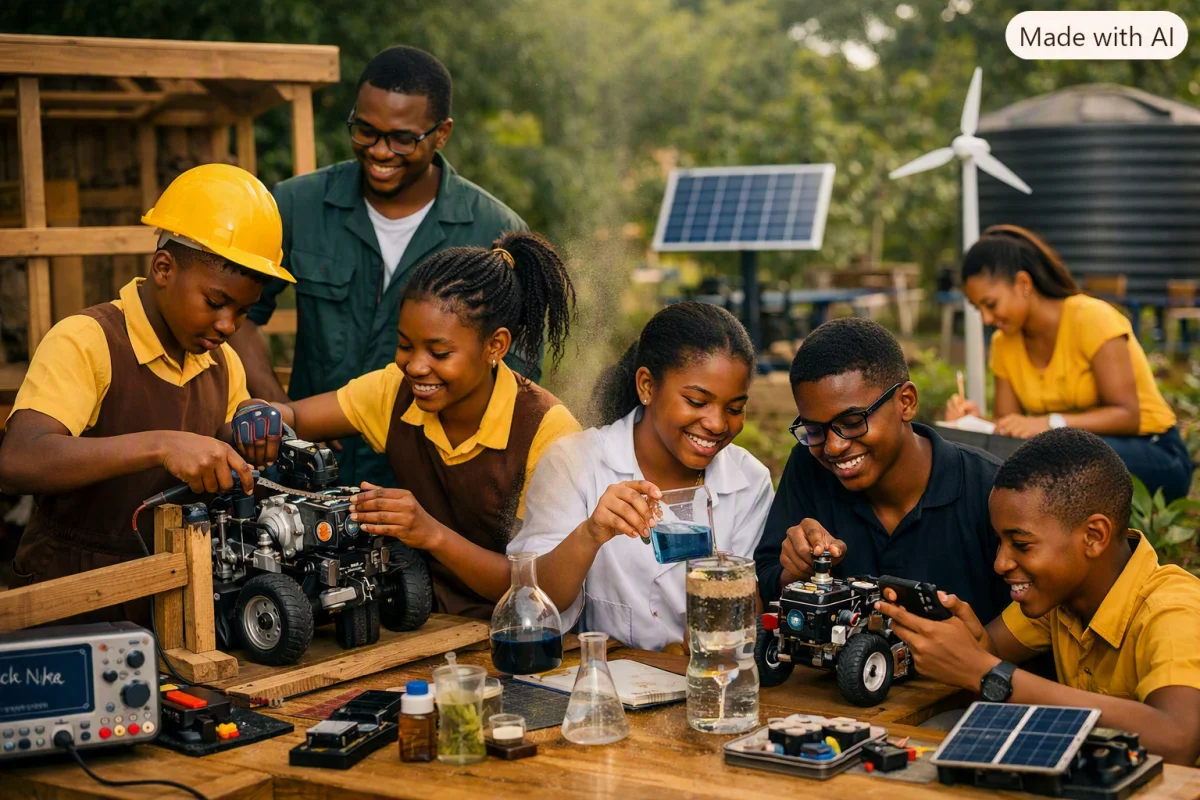
The transition from knowledge consumption to knowledge production ultimately begins before the university. It begins with the culture of learning established in schools. Learners who are trained primarily to reproduce information may struggle to become researchers, innovators or independent problem-solvers. By contrast, learners who are encouraged to ask questions, examine evidence, challenge assumptions and construct explanations begin to develop the intellectual habits required for knowledge production.
This reinforces the argument developed earlier in this article: innovation cannot be treated as an isolated subject added to an otherwise conventional curriculum. It must shape the way knowledge itself is encountered. A learner should gradually move from asking, "What is the correct answer?" to asking, "How do we know?", "Why does this problem exist?", "What evidence supports this explanation?", and "What else could be done?" These questions transform education from the transmission of settled information into an environment of intellectual investigation.
Such a culture does not diminish the importance of foundational knowledge. Knowledge production requires strong disciplinary foundations. Scientists need scientific knowledge, engineers need mathematics and physics, medical professionals need biological and clinical knowledge, and entrepreneurs need economic and organisational understanding. Creativity without knowledge can become speculation, while knowledge without inquiry can become inert. Productive education must therefore unite foundational knowledge with critical inquiry and application.
The broader goal is to cultivate an African learner who can receive global knowledge without becoming intellectually dependent on it; who can respect established scholarship while questioning its assumptions; who can recognise the value of Indigenous knowledge without romanticising it; and who can move between theory and practice. This learner is neither isolated from the global knowledge economy nor subordinated to it. The learner participates in it as a contributor.
The significance of this transformation extends beyond universities and individual learners. A continent that produces more knowledge relevant to its circumstances strengthens its capacity to make informed policy, develop appropriate technologies, improve production and respond to emerging challenges. Knowledge production consequently becomes an element of economic sovereignty. The objective is not to produce knowledge simply for its own sake, but to expand Africa's capacity to understand, create, adapt and transform.
The movement can therefore be understood as a progression:
Knowledge acquisition → critical inquiry → knowledge production → innovation → application → productive transformation.
This progression places education at the beginning of a much larger developmental process. The educational institution becomes the point at which knowledge is acquired, questioned and reconstructed; the research institution becomes the space in which new knowledge is generated; the innovation ecosystem becomes the mechanism through which ideas are developed; and the productive economy becomes the arena in which knowledge is translated into goods, services, technologies, enterprises and social value.
Africa's developmental challenge is consequently not simply to educate more people. It is to develop educational and knowledge systems capable of producing people who can produce knowledge, improve technologies, solve problems and create value. The movement from knowledge consumption to knowledge production is therefore a necessary bridge between educational reform and productive transformation. It leads directly to the broader question of where this knowledge and innovation must ultimately be directed: the productive sectors of the African economy.
- Education, Innovation and the Productive African Economy
The ultimate significance of educational transformation lies in what it enables societies to produce. Education may expand individual capabilities, strengthen citizenship and deepen intellectual life, but its developmental contribution becomes particularly visible when knowledge is translated into productive activity. For Africa, this translation is critical because the continent's development challenge is not simply a question of increasing economic activity. It involves building productive capacities that can generate value locally, reduce excessive dependence on imported goods and technologies, create meaningful employment and strengthen the resilience of African economies. Education and innovation therefore need to be considered not as separate social and economic domains but as interconnected components of productive transformation.
The relationship can be expressed as a developmental chain:
Education → Skills → Innovation → Production → Enterprise → Employment → Development.
This sequence does not suggest that every learner must become an entrepreneur or that education should be reduced to immediate labour-market requirements. Rather, it demonstrates that educational systems have consequences beyond the classroom. The knowledge, competencies and dispositions cultivated through education influence the ability of individuals and institutions to participate in productive activities. Where education produces strong scientific, technical, creative and entrepreneurial capabilities, it can contribute to a broader productive ecosystem. Where it remains detached from production, research and problem-solving, its economic contribution may remain largely indirect.
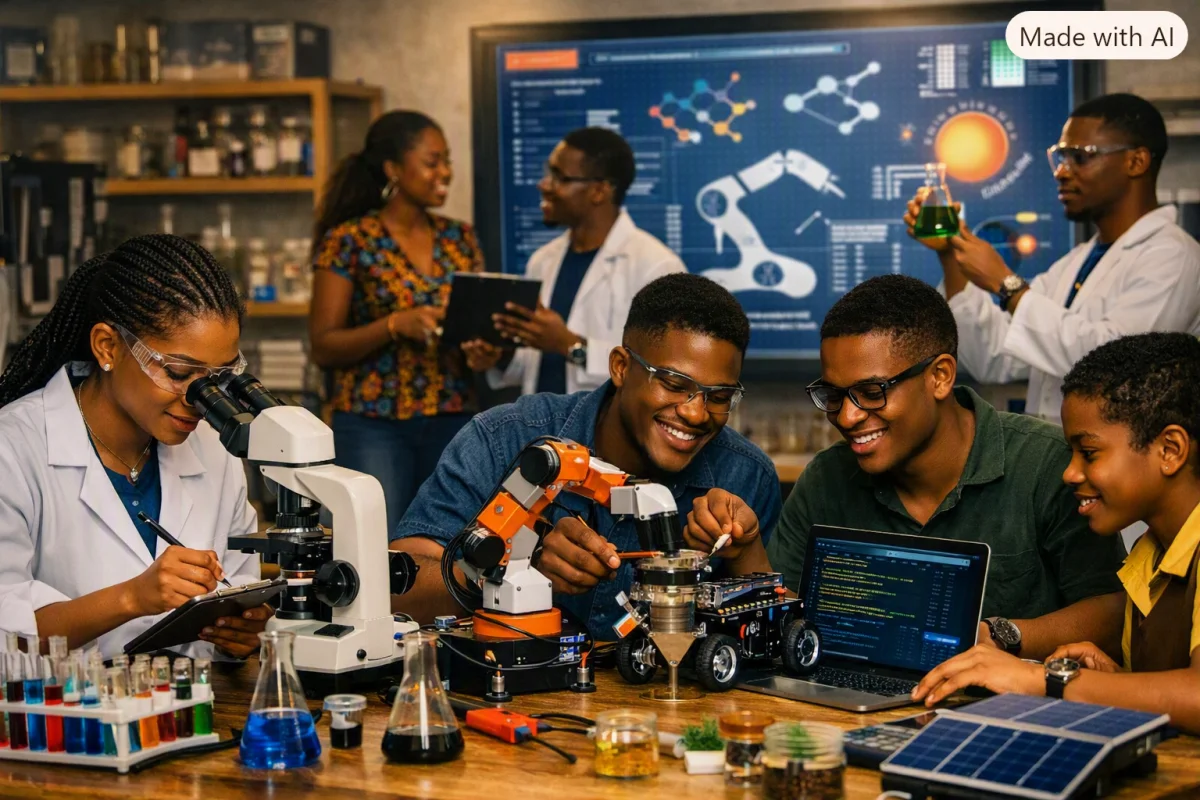
The African Union's Agenda 2063 provides an important continental framework for this relationship. Its vision links a skills revolution underpinned by science, technology and innovation with transformed economies, industrialisation, manufacturing, modern agriculture and value addition. The relationship is significant because it places education within a wider developmental architecture rather than treating it as an isolated social service. Education is expected to contribute to the capabilities through which African economies can diversify, industrialise and generate higher levels of value from their resources.
Agriculture and the movement from production to value addition
Agriculture provides one of the clearest illustrations of why educational innovation matters for productive transformation. The issue is not simply whether Africa produces agricultural commodities. The more consequential question is how much value is created from those commodities within African economies. An educational system oriented towards productive transformation should therefore develop knowledge and skills that extend agricultural production into processing, storage, logistics, packaging, biotechnology, irrigation, mechanisation, food science and agricultural entrepreneurship.
This requires a broader conception of agricultural education. Farming should not be presented merely as a traditional occupation requiring inherited knowledge. It is also a field of science, engineering, business, data analysis and technological innovation. Learners can examine soil conditions, weather patterns, irrigation systems, post-harvest losses, market structures and processing technologies. Universities and technical institutions can work with farmers and agro-processing enterprises to investigate practical challenges and develop context-sensitive solutions.
Such an approach can transform the educational meaning of agriculture. Instead of preparing learners only to seek employment outside the agricultural sector, education can help create agricultural scientists, food technologists, engineers, agribusiness managers, logistics specialists and entrepreneurs capable of strengthening the entire value chain. The productive objective is consequently not simply to produce more raw materials but to increase the knowledge and technological content of agricultural production.
The same principle applies to natural resources. Africa possesses substantial mineral and energy resources, yet resource abundance does not automatically generate broad-based development. Where raw materials are extracted and exported with limited domestic processing, a significant portion of potential value is realised elsewhere. Education can contribute to changing this pattern by developing the scientific, engineering, technical and managerial capabilities necessary for exploration, processing, manufacturing and resource-based innovation.
Manufacturing and industrial capability
Industrialisation provides another critical test of the relationship between education and development. Manufacturing requires more than capital and physical infrastructure. It depends upon engineers, technicians, designers, scientists, managers, skilled operators and researchers capable of improving production systems. An economy seeking industrial transformation therefore needs an education system that can supply technical competence alongside theoretical knowledge.
This is one reason technical and vocational education and training should no longer occupy a marginal position within African educational systems. The African Union's education frameworks explicitly identify TVET, skills development and stronger links between education and the world of work as important elements of continental transformation. Yet the persistence of status hierarchies between academic and technical pathways can weaken this objective. When academic qualifications are consistently associated with higher social prestige while technical occupations are treated as secondary alternatives, educational choices may become disconnected from the skills required to build productive economies.
Repositioning TVET does not mean creating a hierarchy in reverse. It means recognising that productive economies require multiple forms of expertise. A manufacturing system requires researchers who develop new materials, engineers who design machinery, technicians who maintain equipment, digital specialists who optimise processes, managers who organise production and skilled workers who operate complex systems. These roles are complementary rather than competing forms of intelligence.
A productive education system should therefore create permeability between pathways. Learners should be able to move between technical, vocational, academic and entrepreneurial forms of education rather than being permanently categorised by the first educational pathway they enter. Such flexibility can make education more responsive to changing technologies and economic opportunities.
Digital technology and the emerging economy
Digital transformation adds another dimension to the relationship between education and production. Digital technologies have altered how information is created, communicated and used, while artificial intelligence, data systems, software development and digital platforms are creating new forms of economic activity. Yet access to digital technology alone does not constitute innovation. The developmental question is whether African societies possess the human capabilities to create, adapt and deploy these technologies for local purposes.
This distinction is increasingly recognised at the continental level. The African Union's current education initiatives connect digital transformation with the broader transformation of learning and skills development, while its innovation programmes emphasise moving beyond isolated innovations towards systems capable of scaling solutions across contexts.
Education consequently has to move beyond teaching learners how to use digital tools. It should also expose them to the principles underlying those tools. Coding, data literacy, computational thinking, digital design, cybersecurity, artificial intelligence and technology entrepreneurship can enable learners to become creators rather than permanent users of imported digital products.
The distinction between users and creators is economically significant. An economy that imports most of its digital solutions may participate in the digital economy as a consumer. An economy that develops software, platforms, digital services, artificial intelligence applications and technological infrastructure can participate as a producer. Africa does not need to reproduce every technological capability independently, but it does need sufficient technical capacity to adapt global technologies, develop locally relevant applications and participate meaningfully in technological value chains.
Renewable energy and locally relevant innovation
Energy provides another area in which education can contribute directly to productive transformation. Reliable and affordable energy is foundational to manufacturing, agriculture, transportation, health services, education and digital connectivity. Consequently, the development of renewable energy technologies is not merely an environmental concern. It is also a productive and educational opportunity.
Engineering and technical education can connect learners to practical challenges involving solar energy, energy storage, electrical systems, energy efficiency and decentralised power generation. Universities can partner with communities, industries and public institutions to test technologies under African environmental and economic conditions. Such collaboration can generate both knowledge and practical solutions.
The broader lesson is that African development challenges can themselves become laboratories for innovation. A shortage of reliable energy, for example, can be approached not only as a problem requiring external assistance but also as a research question: What energy systems are affordable, sustainable and technically appropriate for particular communities? What materials and technologies are available locally? How can energy systems be maintained over time? What financing models can support adoption?
Questions of this kind transform social problems into opportunities for research, experimentation and productive learning.
Health, construction and public infrastructure
The same educational logic applies to health and infrastructure. African societies require health professionals, biomedical researchers, laboratory scientists, engineers, architects, construction specialists and technology developers who understand both global standards and local conditions. Educational institutions can contribute by directing research and practical learning towards problems such as healthcare access, medical equipment, water systems, sanitation, housing and urban mobility.
The objective is not to isolate African education from global knowledge. Medical science, engineering and other disciplines depend on international research. The challenge is to strengthen the capacity to interpret and apply that knowledge within African contexts. A medical technology designed for a high-income environment may not automatically be the most appropriate solution for a rural African setting. Engineers, scientists and health professionals therefore require the ability to adapt knowledge to differences in infrastructure, cost, climate, population distribution and available resources.
This is precisely where innovation becomes a developmental capability. Innovation allows existing knowledge to be reorganised around particular circumstances. It enables societies to ask not only what solution exists but whether that solution can be modified, simplified, redesigned or combined with other approaches to respond more effectively to local needs.
The creative economy as productive knowledge
Productive transformation should also extend beyond conventional sectors such as agriculture and manufacturing. Africa's creative industries offer opportunities in music, film, literature, fashion, design, animation, publishing, gaming and digital media. These sectors depend heavily upon knowledge, creativity, cultural expression and technological competence.
An education system that treats creativity as secondary to conventional academic achievement can therefore overlook a significant productive resource. Creative education should develop not only artistic expression but also design thinking, digital production, intellectual property awareness, entrepreneurship, communication and market analysis. This can help learners understand how creative work can generate cultural and economic value without reducing creativity to commercial activity alone.
The creative economy also demonstrates why African knowledge and cultural resources should be considered assets rather than merely objects of preservation. African languages, histories, artistic traditions and cultural forms can provide foundations for new products, services and intellectual property. Education can enable learners to engage these resources critically and creatively, producing new forms of cultural expression while participating in global markets.
From employment seekers to value creators
The relationship between education and employment requires particular reconsideration. In many educational systems, the dominant aspiration is to obtain a qualification that increases the probability of securing formal employment. This aspiration is understandable, particularly where unemployment and economic insecurity are significant. Yet if education is organised almost exclusively around employment seeking, it can reinforce dependence on a labour market that may not have sufficient capacity to absorb growing numbers of graduates.
A productive education system must therefore develop both employability and value-creation capacity. Learners should be prepared to work within existing organisations while also possessing the ability to identify problems, improve processes, develop services, conduct research and create new economic opportunities. Entrepreneurship in this context should not be reduced to the establishment of small businesses. It should be understood more broadly as a capacity to recognise opportunities, mobilise resources and create value.
This distinction is important because not every graduate needs to become an entrepreneur. Hospitals, universities, manufacturing firms, government agencies and established companies all require innovative employees who can improve existing systems. Innovation can occur within an organisation just as it can occur through the creation of a new enterprise.
The developmental objective is therefore broader than self-employment. It is to cultivate people capable of contributing to productivity wherever they operate.
Connecting education to productive ecosystems
Education alone cannot transform an economy. Schools and universities require an enabling environment in which knowledge and innovation can be applied. Productive transformation depends upon infrastructure, financing, policy, institutions, markets, research systems and private-sector capacity. The educational sector must therefore be connected to these wider systems.
This requires stronger relationships among universities, TVET institutions, industries, government agencies, research organisations, communities and financial institutions. Universities can identify research problems in collaboration with industry. Industries can provide practical environments for students and researchers. Government can create regulatory and financial conditions that encourage innovation. Communities can contribute contextual knowledge and help evaluate whether proposed solutions respond to real needs.
Such relationships can also reduce the distance between learning and work. Internships, apprenticeships, field research, industry-based projects and community innovation programmes can expose learners to the realities of production before they complete their education. UNESCO's work on higher education in Africa similarly emphasises stronger connections among higher education, research, innovation, industry and workplace learning.
The resulting system is more dynamic than the conventional educational model. Knowledge flows from universities into society, but it also flows from society into universities. Industry problems can become research questions. Community practices can become subjects of investigation. Research findings can become technologies. Technologies can become enterprises. Enterprises can generate employment and further problems for researchers to solve. Productive transformation thus becomes a circular process rather than a linear transfer of knowledge from classroom to labour market.
The central argument of this section is therefore that education should be evaluated partly by its capacity to strengthen the productive capabilities of society. This does not reduce education to economics. Education remains important for citizenship, culture, personal development and social cohesion. However, in a continent seeking structural transformation, these functions must coexist with the capacity to generate knowledge, technologies, enterprises and productive competencies.
The question facing African education is consequently not whether graduates should obtain jobs. It is whether educational systems can contribute to economies in which graduates possess the capacity to enter existing occupations, improve them, create new forms of work and participate in the production of goods, services and knowledge.
This is the point at which the article's argument converges. Education supplies knowledge and capability; innovation converts capability into new or improved solutions; production converts solutions into economic and social value. When these processes are institutionally connected, education becomes more than preparation for participation in an economy. It becomes one of the mechanisms through which the economy itself can be transformed.
The next challenge, therefore, is to move from these interconnected principles towards a coherent educational model that places productive transformation at the centre of learning. Such a model must explain not only what African education should teach, but how knowledge, critical thinking, creativity, innovation and production can be organised into a continuous developmental process.
- Towards an African Model of Productive Education
The preceding discussion has established that the central challenge facing African education is not adequately captured by questions of access, enrolment or certification. The deeper concern is the relationship between education and the productive capacities of society. If education is expected to contribute to innovation and development, then the organisation of learning must enable knowledge to move through a sequence in which it is acquired, questioned, developed, applied and transformed into value. This requires more than isolated reforms to curriculum, assessment or technology. It requires a coherent educational philosophy that places productive capability at the centre of the learning process.
This article proposes what may be termed the Productive Education Model. The model is based on the proposition that education should cultivate a continuous movement from knowledge to critical thinking, critical thinking to creativity, creativity to innovation, innovation to production, and production to economic and social transformation.
Knowledge → Critical Thinking → Creativity → Innovation → Production → Transformation
The model does not suggest that education should be reduced to economic production. Education has intellectual, cultural, ethical, civic and personal purposes that remain indispensable. Rather, it argues that productive capability should become a more explicit dimension of educational purpose in societies seeking structural transformation. The learner should not be prepared only to reproduce existing knowledge or occupy an existing position within the economy. The learner should also be prepared to interrogate knowledge, generate possibilities, solve problems and contribute to the creation of new forms of value.
From knowledge to critical thinking
Knowledge constitutes the foundation of the model. Innovation without knowledge is difficult to sustain because meaningful innovation requires an understanding of existing conditions, principles, evidence and possibilities. The objective, therefore, is not to abandon disciplinary knowledge in favour of creativity or practical activity. It is to change the relationship learners have with knowledge.
In a conventional examination-oriented system, knowledge can become something to be memorised for assessment. Within a productive education system, knowledge becomes a resource for investigation. Learners are encouraged to ask questions about what they encounter, examine evidence and identify relationships among ideas. Critical thinking therefore functions as the first transformation of knowledge.
The distinction is important. Knowing the principles of environmental science is different from using those principles to investigate pollution in a local community. Knowing mathematical procedures is different from using mathematics to analyse household expenditure, agricultural yields or market trends. Knowing the principles of physics is different from applying them to examine energy efficiency. In each case, the knowledge remains important, but its educational value expands when the learner can interrogate and mobilise it.
Critical thinking consequently prevents knowledge from becoming static. It creates the intellectual conditions under which learners can move from accepting information to examining its meaning, evidence and application.
From critical thinking to creativity
Critical thinking alone does not guarantee innovation. A learner may identify a problem accurately without imagining an alternative solution. The next movement in the model is therefore creativity.
Creativity involves the capacity to generate possibilities, make connections between apparently unrelated ideas and imagine alternatives to existing arrangements. In education, this means creating spaces in which learners are not always presented with one predetermined route to a solution. Open-ended questions, design challenges, experimentation and interdisciplinary projects can encourage learners to consider multiple possibilities.
For African education, creativity is particularly important because many development challenges require solutions adapted to specific social, environmental and economic conditions. A solution that works in one context may require substantial modification in another. Creativity allows learners to move beyond the assumption that development consists primarily of importing already established solutions.
The importance of creativity should not, however, be confused with unrestricted originality. Productive creativity requires knowledge, discipline and evaluation. An idea becomes educationally meaningful when learners can explain why it may work, test its assumptions and improve it in response to evidence.
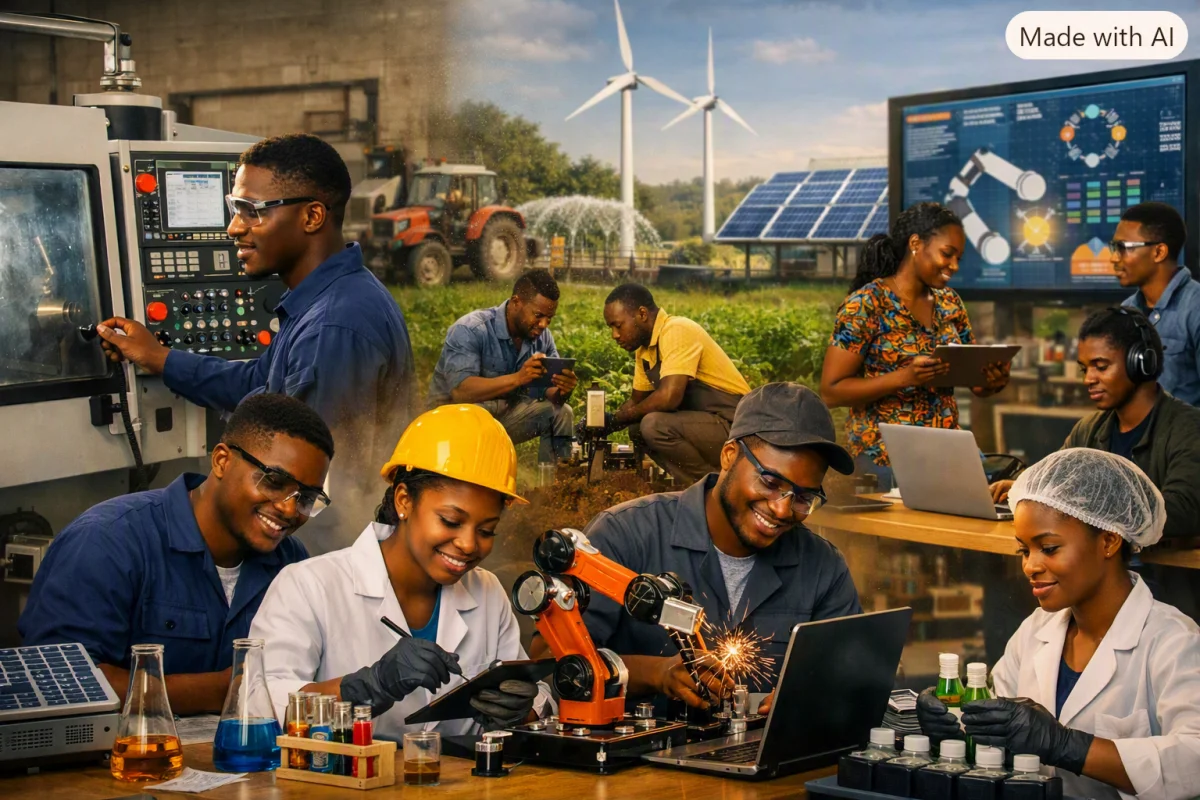
From creativity to innovation
The movement from creativity to innovation is where ideas acquire practical direction. Creativity may generate possibilities, but innovation concerns the development, adaptation or application of ideas in ways that produce meaningful improvement.
This distinction allows the model to avoid treating every new idea as an innovation. A classroom can produce many creative ideas that never become viable solutions. Innovation requires experimentation, testing, adaptation and implementation. It also requires attention to the needs of the people or systems for whom a solution is intended.
The African Union's current education and innovation agenda increasingly reflects this orientation. Its education strategy emphasises knowledge, competencies, skills, innovation and creativity, while its science, technology and innovation framework positions innovation as central to Africa's transition towards a knowledge-based economy. The AU's recent work on higher education and TVET likewise emphasises competency-based learning, entrepreneurship, work-based learning, industry-academia partnerships and innovation ecosystems.
The Productive Education Model therefore treats innovation not as a specialised activity reserved for scientists, technology companies or exceptional students. It is a capability that can be cultivated across disciplines. A literature student can innovate through new forms of storytelling or cultural production. A teacher can innovate through pedagogy. An agricultural student can innovate through improved production methods. A business student can innovate through new organisational or market strategies. An engineer can develop technological solutions. The common principle is the transformation of knowledge into improved practice.
From innovation to production
Innovation acquires greater developmental significance when it enters the productive sphere. Production in this model should be understood broadly. It includes the creation of goods and services, technologies, enterprises, research outputs, cultural products, public services and social solutions.
This broader understanding is important because production is often associated narrowly with factories. Yet contemporary economies produce value through agriculture, manufacturing, digital technologies, health services, construction, finance, education, creative industries and scientific research. A productive education system should therefore prepare learners to recognise opportunities for value creation across multiple sectors.
The African Union's Agenda 2063 explicitly connects education and skills development with science, technology and innovation, transformed economies, manufacturing, industrialisation, value addition and agricultural productivity. The Productive Education Model brings these relationships into the educational process itself.
A learner should therefore encounter production not only after graduation. Production can become part of learning. Students can design products, conduct research, develop prototypes, undertake community projects, analyse markets, improve processes or create digital solutions as components of their education. Such experiences change the meaning of learning because the learner begins to see knowledge as something capable of producing an outcome.
From production to transformation
Production alone does not necessarily constitute development. An economy may produce goods while remaining highly unequal, environmentally unsustainable or technologically dependent. The final movement in the model is therefore transformation.
Transformation refers to the broader improvement of productive capacity, technological capability, social wellbeing and economic resilience. It involves increasing the value generated within African economies, strengthening local capabilities, diversifying production and improving the conditions under which people live and work.
This distinction is especially important in relation to natural resources. Extracting and exporting raw materials constitutes economic activity, but productive transformation requires increasing the capacity to process, manufacture and create value from those resources. Similarly, importing technology can provide immediate benefits, but technological transformation requires the ability to understand, adapt, maintain and eventually improve technologies.
Education contributes to this transformation by cultivating the human capabilities required at every stage of the process. Scientists generate knowledge. Engineers develop technologies. Technicians maintain and improve systems. Entrepreneurs organise resources. Researchers investigate problems. Designers create products. Teachers reproduce and extend knowledge. Managers coordinate production. Policy specialists establish enabling environments. These functions are interconnected.
Replacing the examination-to-certificate pathway
The Productive Education Model can be contrasted with a conventional pathway that dominates many education systems:
School → Examination → Certificate → Job
This pathway is not entirely dysfunctional. Examinations can provide mechanisms for evaluating learning, certificates can communicate qualifications, and employment remains an important outcome of education. The problem emerges when the pathway becomes the dominant definition of educational success.
The Productive Education Model proposes a different progression:
Learning → Inquiry → Capability → Creativity → Innovation → Production → Transformation
The difference is not simply terminological. The first pathway tends to measure the successful completion of educational stages. The second asks what learners can do with what they have learned.
This shift also changes the meaning of assessment. If productive capability is an educational objective, assessment must examine more than recall. Learners should be given opportunities to demonstrate reasoning, research, communication, design, collaboration, practical competence and problem-solving. Conventional examinations may remain part of the system, particularly where foundational knowledge needs to be assessed, but they should operate alongside forms of assessment capable of recognising productive capability.
The institutional dimension of the model
The Productive Education Model cannot succeed through classroom reform alone. Educational institutions themselves must become more productive knowledge environments.
Schools can establish laboratories, gardens, workshops, research projects and community-based learning initiatives. TVET institutions can collaborate with industries and local enterprises. Universities can connect teaching with research, innovation and commercialisation. Research institutions can collaborate with government, industry and communities. Such relationships create environments in which learning and production reinforce each other.
The current continental policy direction supports this institutional approach. The African Union's 2026 education and skills initiatives emphasise industry engagement, work-based learning, innovation ecosystems, digital transformation, entrepreneurship, green skills and the scaling of African innovations. These developments demonstrate that the proposed model is consistent with emerging continental priorities, while its distinctive contribution lies in integrating them into a single educational-developmental sequence.
The model also requires a reconsideration of the teacher. The teacher becomes more than a transmitter of established information. The teacher becomes a designer of learning experiences, facilitator of inquiry, guide to experimentation and participant in continuous professional learning. This does not diminish teacher authority. It changes the basis of that authority from possession of information alone to the capacity to help learners investigate and use knowledge meaningfully.
Universities likewise need to reconsider their relationship with society. Their success should not be judged exclusively through enrolment, graduation and publication statistics. Research quality remains essential, but institutions should also ask whether their knowledge contributes to technological development, policy improvement, enterprise creation, social innovation and the resolution of local problems.
An African orientation without intellectual isolation
Calling this an African model does not mean advocating an education system isolated from global knowledge. Africa's educational transformation must remain connected to international scholarship, scientific research and technological development. The distinctive question concerns how global knowledge is received, interpreted, adapted and extended.
An African productive education system should therefore cultivate intellectual openness alongside intellectual agency. Learners should read global scholarship while also examining African realities. They should learn established scientific methods while investigating local problems. They should use global technologies while developing the capacity to adapt them. They should participate in international research while strengthening African research agendas.
The objective is neither rejection nor imitation. It is participation with agency.
This principle is consistent with Agenda 2063's conception of an Africa increasingly capable of building its own knowledge society and strengthening its role in global research, technology development, innovation and knowledge production. The model consequently positions African learners not at the margins of the global knowledge economy but as potential contributors to it.
Towards a productive culture of education
The deepest implication of the model is cultural. Educational transformation cannot occur if society continues to define success primarily through certificates, prestigious occupations and conventional academic status. A productive culture must recognise intellectual, technical, creative and entrepreneurial capabilities as complementary forms of contribution.
This requires changes in how schools celebrate achievement, how families understand educational success, how governments allocate resources, how universities evaluate performance and how industries engage with educational institutions. It also requires greater respect for technical competence and practical intelligence.
The objective is not to create a society in which everyone is compelled to become a scientist, engineer or entrepreneur. It is to create a society in which every learner is encouraged to understand the relationship between knowledge and action.
The Productive Education Model therefore offers a conceptual bridge between educational reform and African development. It begins with the recognition that knowledge matters, but refuses to treat knowledge acquisition as the endpoint. Knowledge must stimulate inquiry. Inquiry must generate creativity. Creativity must create possibilities for innovation. Innovation must find pathways into production. Production must contribute to broader economic and social transformation.
The model can consequently be summarised as follows:
Knowledge provides the foundation.
Critical thinking interrogates and mobilises knowledge.
Creativity generates possibilities.
Innovation develops and applies those possibilities.
Production converts innovation into goods, services, technologies and social value.
Transformation expands productive capacity and improves economic and social conditions.
This sequence provides a different way of thinking about the purpose of African education. The central question is no longer simply whether education produces graduates. It becomes whether education produces capable thinkers, skilled practitioners, researchers, innovators, creators and problem-solvers who can participate in transforming their societies.
The challenge now is implementation. A model of productive education has little value if it remains conceptual. Its significance depends upon whether policymakers, teachers, universities, industries and communities can translate its principles into educational practice. The future of African education will therefore depend not only on expanding access, but on deciding what kind of capabilities that expansion is intended to produce and what kind of continent those capabilities are expected to build.
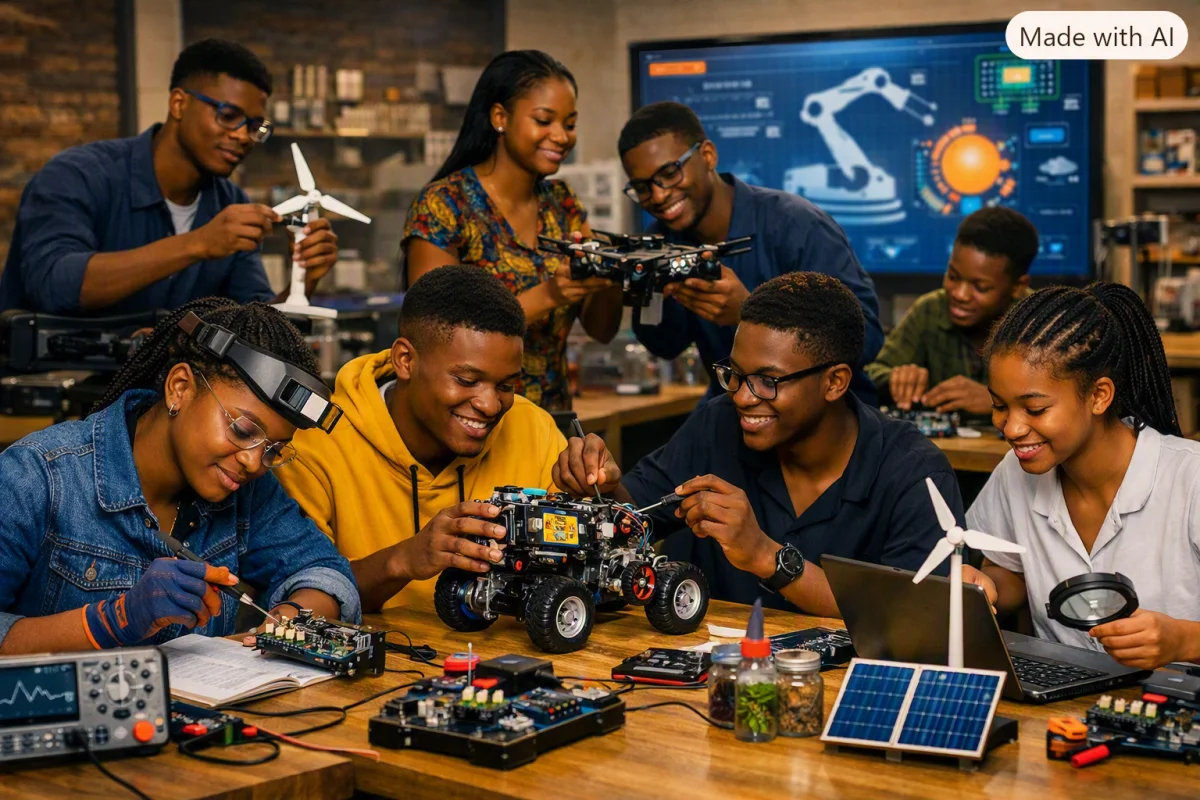
Conclusion
The question of Africa's educational future cannot be separated from the question of Africa's developmental future. Across the continent, educational systems have expanded access, produced growing numbers of graduates and increased participation in formal learning. Yet expansion alone does not guarantee productive transformation. The more fundamental issue is whether education develops the intellectual, technical, creative and practical capacities required to generate knowledge, solve problems, create value and strengthen productive economies.
This article has argued that contemporary Africa requires a reorientation of education from a predominantly credential-centred model towards an innovation-centred and production-oriented model. The argument does not dismiss the importance of qualifications, academic knowledge or employment. Rather, it questions their treatment as the ultimate endpoints of education. A certificate can demonstrate that a learner has completed a course of study, but it does not by itself demonstrate the capacity to investigate problems, generate knowledge, innovate or transform knowledge into productive outcomes.
The discussion has consequently reframed the educational challenge through the relationship among knowledge, innovation and production. Education provides the knowledge and capabilities from which critical inquiry emerges. Critical inquiry creates the conditions for creativity. Creativity provides possibilities for innovation. Innovation creates opportunities for production, while productive capacity provides a foundation for broader economic and social transformation. Education therefore becomes developmentally significant not merely because it produces educated individuals, but because it can strengthen the capacity of societies to understand their circumstances and transform them.
This argument also requires a reconsideration of the meaning of innovation. Innovation should not be reduced to advanced digital technologies or imported technological products. It includes the capacity to adapt knowledge, improve processes, develop appropriate technologies, create new services, strengthen existing industries and respond creatively to social problems. Such a conception is particularly relevant to Africa because the continent's developmental challenges are also potential sites of innovation. Agriculture, energy, health, manufacturing, construction, transportation, environmental management and the creative industries all provide contexts in which educational knowledge can be converted into practical solutions.
The article's central conceptual contribution is the Productive Education Model:
Knowledge → Critical Thinking → Creativity → Innovation → Production → Transformation
This model offers an alternative to an educational pathway dominated by:
School → Examination → Certificate → Job
The distinction between the two pathways is fundamental. The first measures educational progression largely through institutional completion and credential acquisition. The second focuses on the progressive development of capabilities through which learners can contribute to knowledge, innovation and production. The proposed model therefore does not seek to eliminate examinations, certificates or employment. It seeks to reposition them within a broader conception of educational purpose.
For this model to become meaningful, however, educational reform must occur across the system. Curriculum needs to connect disciplinary knowledge with real problems. Pedagogy must create greater space for inquiry, experimentation and collaboration. Assessment must recognise reasoning, application, creativity and practical competence alongside knowledge recall. Teacher education must prepare educators to facilitate inquiry rather than rely exclusively on information transmission. TVET must be treated as an essential component of productive development rather than as a lower-status alternative to academic education. Universities must strengthen the relationship among teaching, research, industry and society. Indigenous and local knowledge should be investigated critically and placed in productive dialogue with global scientific knowledge. Digital technologies should be treated as instruments for expanding human capability rather than as substitutes for educational transformation.
These changes also require policy coherence. Education ministries cannot transform education independently of ministries responsible for industry, agriculture, science and technology, employment, finance and economic planning. If educational institutions are expected to produce innovators, researchers and technically skilled professionals, national development policies must provide environments in which their knowledge can be used. Research funding, infrastructure, intellectual property systems, industrial policy, entrepreneurship support and university-industry partnerships are therefore part of the wider educational question.
The responsibility also extends beyond governments. Universities, industries, communities, teachers, parents and learners all influence the culture through which educational success is defined. A society that measures achievement almost exclusively through certificates and prestigious occupations may unintentionally discourage technical, creative and entrepreneurial forms of contribution. Productive transformation requires a broader recognition of different forms of intelligence and expertise.
At the continental level, this reorientation is compatible with the direction of African development frameworks that place education, skills, science, technology and innovation within the broader project of economic transformation. The African Union's Agenda 2063 and education strategies increasingly connect skills development with innovation, research, industrialisation, value addition and transformed economies. UNESCO's recent work on transforming learning and skills in Africa similarly emphasises the need for education systems that respond more effectively to the continent's economic and social realities.
The significance of the argument, therefore, extends beyond educational policy. It concerns the kind of society Africa seeks to build. A continent that primarily consumes knowledge, technologies and finished products will remain vulnerable to external dependence even when educational attainment increases. A continent that develops the capacity to produce knowledge, adapt technologies, create enterprises, manufacture goods, develop services and solve its own problems acquires greater productive and intellectual agency.
Reimagining education for African development consequently requires a shift in the question being asked. The issue is no longer simply how many people can Africa educate? It is also what can educated people do with what they know? That question moves the discussion from access to capability, from certification to competence, from consumption to production and from educational expansion to productive transformation.
Africa does not need an educational system designed merely to reproduce existing patterns of knowledge and employment. It requires an educational culture capable of preparing people to question inherited assumptions, generate new knowledge, adapt global ideas, develop local solutions and create productive possibilities. Such a system would not only prepare Africans for the future. It would equip Africans with greater capacity to shape that future.
The task, therefore, is not to abandon education as it exists, but to rethink its ultimate direction. Education must become a stronger foundation for innovation, innovation a pathway to production, and production a mechanism for transformation. In this reorientation lies the possibility of moving beyond an education system that primarily certifies participation towards one that actively cultivates the human capabilities required for a more productive, innovative and self-directed Africa.
What's Your Reaction?
 Like
0
Like
0
 Dislike
0
Dislike
0
 Love
0
Love
0
 Funny
0
Funny
0
 Wow
0
Wow
0
 Sad
0
Sad
0
 Angry
0
Angry
0

A PAN AFRICAN CRUSADER

















Comments (0)