

Germany’s Persistent Unemployment Signals Deep Structural Shifts in Its Labour Market
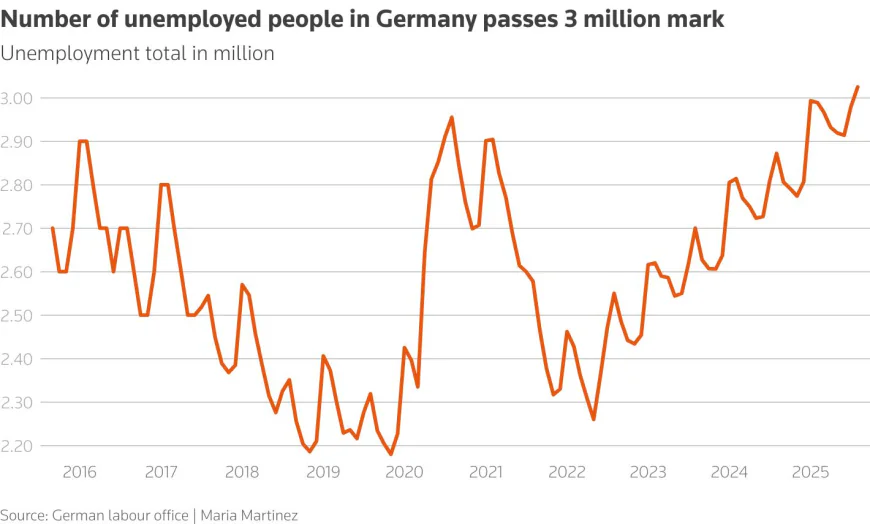
Germany’s unemployment holding above 3 million signals not just a stalled recovery, but a deeper structural strain in Europe’s largest economy — with consequences that could ripple across the eurozone and global markets.
Events Leading Up to It
Germany’s labour market, once one of Europe’s strongest, has been showing signs of sustained strain over recent years. After enjoying a tight labour market throughout much of the 2010s and early 2020s, unemployment began rising in mid-2024 as economic growth slowed and structural pressures intensified.
Industry — particularly manufacturing and the automotive sector — has faced weakening demand, rising production costs, and competition from abroad, all of which have led to reduced hiring and job cuts. Regional data revealed rising unemployment in key industrial hubs like Baden-Württemberg, where structural shifts have weighed heavily on employment levels. Baden-Württemberg is a state in southwest Germany bordering France and Switzerland.
According to Reuters “Baden-Wuerttemberg's economy shrank by 0.4% in 2024, more than the 0.2% decline in Germany as a whole and, while the country returned to modest growth last year, the state is expected to have contracted again.”
These trends have unfolded against the backdrop of broader economic stagnation: Germany’s economy has struggled with weak domestic and export demand for over three years, and consumer confidence has dipped as households become cautious about spending.
Labour market indicators have reflected this malaise, with vacancies declining and fewer recruitment plans reported by firms.
Declining vacancies indicate that firms are not merely pausing hiring but reassessing long-term investment decisions amid structural uncertainty in key sectors.
Government efforts to stimulate growth — including pledges for increased infrastructure and defence spending — have so far had limited impact on reversing job losses, and political pressure is rising as state elections approach.
Domestic Implications for Germany
A flag with the logo of the German employment agency flies in the wind. Philip Dulian/dpa
Weak Economic Growth and Labour Market Slump
According to the federal employment agency “unemployment fell by 15,000 to 3,070,000 in February 2026. Seasonally adjusted, it has practically not changed compared to the previous month at +1,000. The unemployment rate fell by 0.1 percentage points to 6.5 percent. Compared to February of last year, the number of unemployed is 81,000 higher. The unemployment rate increased by 0.1 percentage points compared to the same month last year.”
This persistent plateau in unemployment reflects broader economic headwinds. According to economic forecasts, after two years of near-stagnation, Germany’s real GDP growth is only expected to moderately strengthen (e.g., projected growth of approximately 1.2 % in 2026), indicating sluggish macroeconomic momentum that is unlikely to sharply reduce joblessness in the near term.
Even if prices are starting to stabilise and interest rates are lowered, that alone may not solve Germany’s unemployment problem.
The real issue might be that the kinds of jobs being created today require different skills from the ones many workers currently have.
As industries change because of new technology and stronger global competition, people who lose jobs in traditional manufacturing may struggle to move into growing fields like green energy or digital services.
In this situation, long-term solutions — such as retraining workers, supporting innovation, and helping people move into new jobs — may be more effective than simply trying to boost spending in the short term.
Fiscal and Social Pressure
Fiscal and social pressure occurs when high unemployment forces governments to spend more on welfare while receiving less tax revenue, while at the same time creating economic hardship and instability within society.
Sustained unemployment above 3 million puts pressure on public finances:
Higher social welfare spending: prolonged joblessness typically increases demand for unemployment benefits and retraining programmes.
Lower tax receipts: weaker employment growth reduces income tax revenue, potentially widening fiscal deficits if economic growth remains subdued.
Despite some easing in inflation — which dipped unexpectedly to around 2 % in February 2026 — consumer confidence and household spending remain cautious, slowing domestic demand and delaying a stronger labour market recovery.
Regional and Euro Area Impact
Slower Eurozone Growth
According to KPMG “with a gross domestic product of €4,470 billion in 2025, Germany remains the world's third-largest economy after the United States and China and just ahead of Japan, making it the largest economy in Europe”.
Germany accounts for a significant share of euro area output and trade, continued weakness in its labour market and economy can dampen broader regional growth.
Exports and industrial output from Germany are major drivers of intra-EU trade. A persistently weak labour market tends to signal reduced economic activity and lower demand for imported goods from neighbouring economies.
If Germany’s unemployment stays elevated, it could contribute to higher euro area unemployment trends, slowing investment and consumption across the bloc.
Although the euro area’s overall unemployment rate was around 6.2 % in mid-2025, Germany’s experience highlights a divergence in recovery momentum and structural labour challenges that could make eurozone policy coordination more complex.
Policy Responses and Monetary Considerations
The European Central Bank (ECB) primarily aims to maintain price stability, targeting inflation at around 2% over the medium term.
Although employment is not its main mandate, labour market conditions play a key role in shaping monetary policy decisions. When unemployment remains high — such as Germany’s jobless total staying above 3 million — it signals weakening economic momentum in the eurozone’s largest economy.
With inflation easing but labour demand still soft, the ECB faces a delicate balancing act. Weak employment reduces wage pressures and lowers the risk of persistent inflation, which could justify interest rate cuts.
However, cutting rates too quickly could risk reigniting price pressures if inflation proves sticky. On the other hand, keeping rates high for too long could further slow growth and increase unemployment across the euro area.
As a result, the ECB must adopt a cautious, data-dependent approach, carefully balancing inflation control with the need to support jobs and broader economic stability.
Global Economic Significance
Trade and Investment Links
Germany’s labour market health has ripple effects well beyond Europe:
Global supply chains: Germany is a major exporter of machinery, vehicles, and industrial goods. Weak domestic demand and persistent unemployment can reduce export volumes, affecting trading partners, especially in Asia and Eastern Europe.
Confidence and investment: Continued sluggish performance can weigh on foreign direct investment (FDI), as companies reassess the attractiveness of Germany as a production base.
Germany’s experience — high unemployment persisting in a major advanced economy — offers a cautionary example for other nations facing demographic headwinds, technological change, and global competition.
Policies focusing on reskilling, labour mobility and structural reform may be essential to mitigate long-term joblessness.
What's Your Reaction?
 Like
0
Like
0
 Dislike
0
Dislike
0
 Love
0
Love
0
 Funny
0
Funny
0
 Wow
0
Wow
0
 Sad
0
Sad
0
 Angry
0
Angry
0

I’m a freelance writer with a passion for business, lifestyle, and opinion pieces that explore culture, trends, and real-world insights. I bring a perspective that blends professional knowledge with cultural awareness, drawing on my experience in real estate and a keen interest in South Asian lifestyle and culture. I hold a Master’s in Popular Music Practice, and outside of writing, I enjoy playing the flute and reading about philosophy and psychology. I love crafting engaging, thought-provoking stories and am always excited to pitch fresh ideas or take on features that connect communities, trends, and the bigger picture.
















Comments (0)