

German Exports to U.S. Plunge in 2025 Amid Trump Tariffs
Germany’s exports to the United States have fallen sharply as renewed U.S. tariffs, currency pressures and intensifying global competition strain one of Europe’s most important trade relationships.
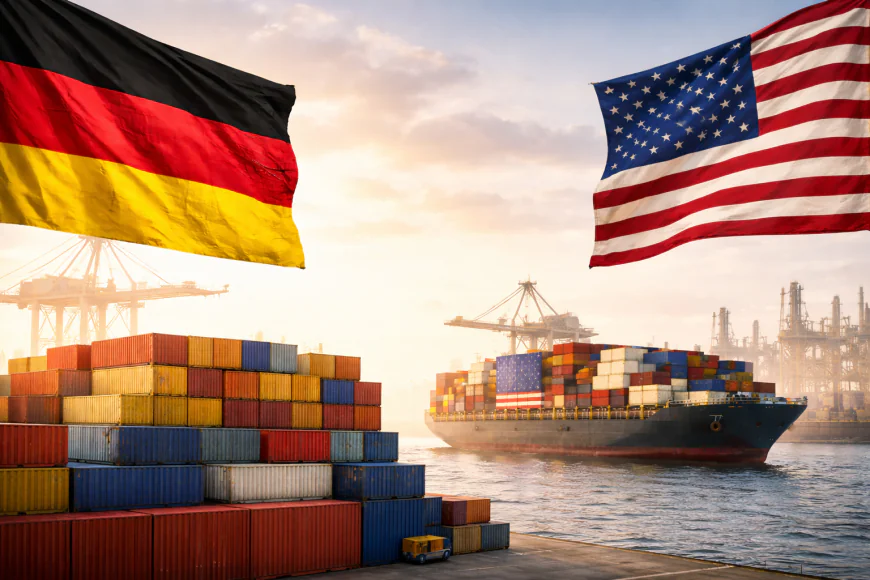
In 2025, Germany — Europe’s largest economy and one of the world’s most trade-oriented — experienced a sharp downturn in exports to the United States as a result of aggressive U.S. tariff policy under President Donald Trump.
The fall in shipments has reverberated across German industry, rattled investor confidence and raised difficult questions about the future of transatlantic economic relations.
From Powerhouse to Pressure: What Has Happened to German–U.S. Trade
According to official figures from the Federal Statistical Office, German exports to the U.S. declined by 9.4 % in the first eleven months of 2025, falling to €135.8 billion — a significant drop compared with 2024 and the lowest level in several years outside the COVID-19 pandemic period.
At the same time, imports from the United States increased slightly by 2.2 % to €86.9 billion, shrinking Germany’s trade surplus with the U.S. to €48.9 billion — its lowest since 2021.
The impact has been especially pronounced in Germany’s hallmark export sectors. Automotive exports, long a cornerstone of “Made in Germany”, plunged 17.5 % to €26.9 billion, while machinery exports fell 9 % and other manufactured goods also declined. Only pharmaceuticals rose slightly by 0.7 %, underscoring that even diversified export sectors are under strain.
The drop in exports to the United States was a major reason why Germany’s overall exports have barely grown for the third year in a row, even though sales to other countries — including those in Europe — helped make up for some of the losses.
German direct investment in the U.S. also took a hit in 2025. A report by the German Economic Institute (IW) found that German investment in the United States nearly halved, falling 45 % from €18.5 billion in early 2024 to around €10.2 billion between February and November 2025.
This represents a 24 % drop below the decade-average and is widely seen as a reflection of uncertainty caused by abrupt tariff changes.
Tariffs, Tensions and Trump: Why Germany’s Exports Are Falling
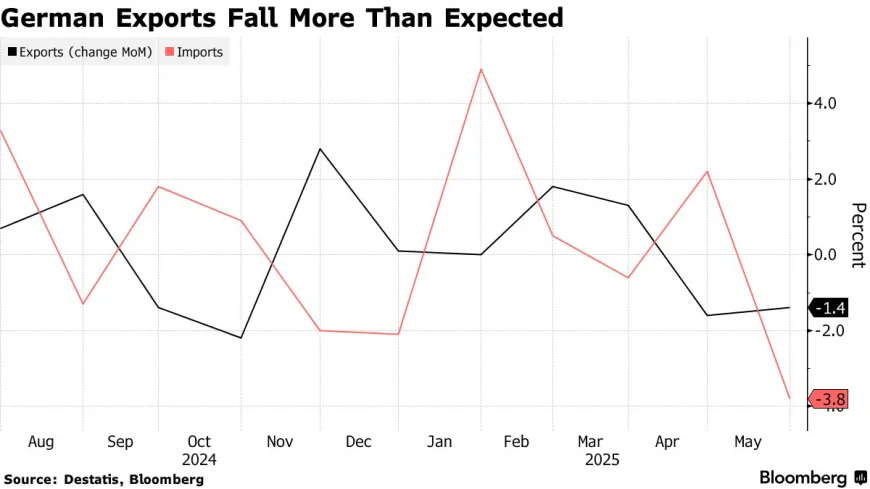
The primary driver behind the plunge in exports and investment has been the reintroduction and expansion of U.S. tariffs on European imports under President Trump.
These tariffs — including levies as high as 50 % on steel and aluminium products and significant duties on auto parts and machinery — were explicitly designed to protect U.S. industry by making imported goods more expensive and encouraging foreign firms to relocate production to the U.S.
President Trump has repeatedly criticised Germany for its trade surpluses with the United States, especially in cars and machinery, calling them “unfair” and damaging to American workers.
The tariff campaign is part of a broader strategy to reduce the U.S. trade deficit and rebalance industrial activity.
Economists in Germany note that such policies have created “zigzag trade policy” conditions that make reliable business planning very difficult for exporters. “Because of the zigzag trade policy of the U.S., companies can no longer do reliable planning,” said Alexander Kruger, chief economist at Hauck Aufhäuser Lampe.
The direct cost of tariffs has also been compounded by exchange rate movements — a stronger euro relative to the dollar has made German goods more expensive abroad — and by broader global competition, particularly from China
According to the Financial Times, "Ruth Brand, president of the country’s federal statistical office, cited higher US tariffs, the appreciation of the euro and increased competition from China for exporters’ woes".
Industry leaders have underscored the impact of these policy shifts. Falker Trayer, head of foreign trade at the German Chamber of Industry and Commerce (DIHK), described 2025 as “a year with record burdens on foreign trade — especially due to U.S. trade policy.”
In addition to direct tariffs, Trump’s administration has used trade policy as leverage in unrelated geopolitical disputes.
According to English News, "experts noted that the Trump administration's use of tariffs as leverage reflects a broader transactional approach to foreign policy, often compared to economic blackmail".
Threats of new tariffs linked to disagreements over Greenland and other issues have added to uncertainty, triggering stock market volatility and investor fears about a broader transatlantic trade war.
A Fractured Alliance: Economic, Political and Strategic Consequences
The implications of the downturn in U.S. demand for German goods are significant and multifaceted, touching on economic growth, industrial strategy and international relations.
Economically, Germany’s export slump has contributed to persistent weakness in overall economic activity.
After two years of contraction, Germany’s GDP finally reported modest growth of 0.2% in 2025, but exports remained weak and private investment was sluggish.
Analysts describe this performance as disappointing for an economy long dependent on trade surpluses. DekaBank’s chief economist described 2025 as “another lost year” given structural headwinds and the drag from exports.
For German industry, especially the automotive sector, the contraction in U.S. sales has forced strategic recalibration.
Mercedes, Volkswagen and other manufacturers have had to absorb some tariff costs or shift production toward other markets or onshore facilities — decisions that require investment and can dampen profitability.
A Reuters review noted that German companies could face hundreds of millions in new tariff costs, with some revising sales forecasts downward as a result.
The investment slowdown — with a near-halving of German investment in the U.S. — is particularly worrying because it reflects not only current trade frictions but longer-term strategic uncertainty. Investors and corporate leaders are reportedly postponing decisions on factories, research facilities, and supply chain integration until policy direction becomes clearer.
Politically, the slump has strained transatlantic ties. Germany and EU leaders have been vocal about the risks of a tariff escalation. Chancellor Friedrich Merz has emphasised the need to “avoid escalation” while affirming Germany’s willingness to defend its interests, including the possibility of retaliatory measures if necessary.
The European Parliament has suspended ratification of a major EU–U.S. trade agreement in response to threats of additional tariffs, highlighting how trade disputes are beginning to affect broader diplomatic relations. The move was described by the chair of the Parliament’s trade committee as a firm response to what many lawmakers view as coercive trade practices.
Retaliation carries risks of its own. According to Reddit, some EU member states have moved to adopt counter-tariffs targeting up to €93 billion of U.S. imports under the bloc’s anti-coercion rules if no agreement is reached — a step that could widen the conflict and provoke further economic pain on both sides.
Strategically, Germany’s experience may accelerate efforts to diversify trade relationships. With China overtaking the U.S. as Germany’s largest trading partner in 2025, policymakers and economists argue that reliance on any single external demand source — especially one subject to sudden policy shifts — carries risk. “There is no question that U.S. tariff and trade policy is an important reason for the decline in sales,” said Dirk Jandura, president of the BGA foreign trade association.
Finally, the situation has raised broader questions about the stability of the global trading system. For decades, the post-World War II order was built on open markets and predictable rules.
The recent spate of tariffs, geopolitical uses of trade policy and volatile negotiations have challenged that model, prompting calls for renewed multilateral engagement and stronger international dispute mechanisms to prevent reciprocal retaliation from undermining growth.
Germany’s export plunge in 2025 is not a simple economic fluctuation — it is the product of deliberate policy choices, international strategic competition and a broader shift in trade norms. The effects will likely continue to shape German industry, European politics and transatlantic economic frameworks into the foreseeable future.
What's Your Reaction?
 Like
0
Like
0
 Dislike
0
Dislike
0
 Love
0
Love
0
 Funny
0
Funny
0
 Wow
0
Wow
0
 Sad
0
Sad
0
 Angry
0
Angry
0

I’m a freelance writer with a passion for business, lifestyle, and opinion pieces that explore culture, trends, and real-world insights. I bring a perspective that blends professional knowledge with cultural awareness, drawing on my experience in real estate and a keen interest in South Asian lifestyle and culture. I hold a Master’s in Popular Music Practice, and outside of writing, I enjoy playing the flute and reading about philosophy and psychology. I love crafting engaging, thought-provoking stories and am always excited to pitch fresh ideas or take on features that connect communities, trends, and the bigger picture.
















Comments (0)