

TWO LAUREUS AWARDS BEFORE 19 : HOW LAMINE YAMAL MADE SPORTING HISTORY
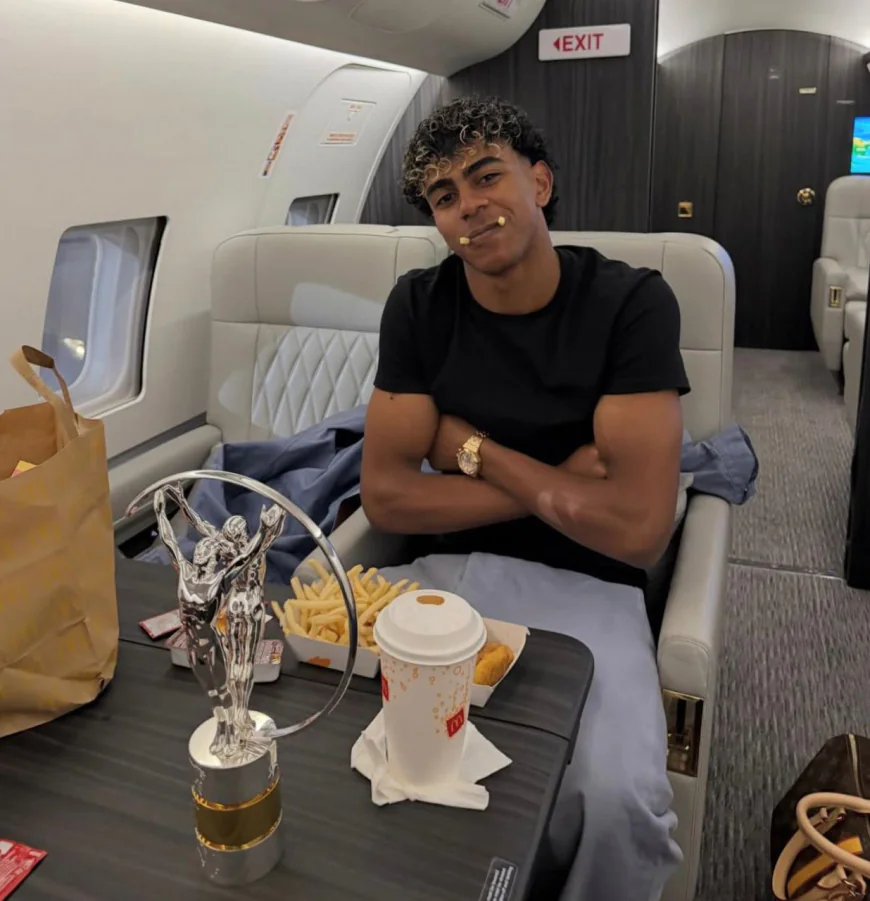
If you walked into the Palacio de Cibeles in Madrid on April 21, 2025, you would have seen the usual Laureus crowd. Rafael Nadal in a dark suit. Novak Djokovic talking to Simone Biles. Tom Brady by the stage. Usain Bolt laughing with Michael Johnson. It is the one night each year where the biggest names in sport all sit in the same room, and they are there to judge each other. That is what makes a Laureus different. It is not voted on by journalists or fans. It is voted on by 69 legends who have actually been to the top of their sports. And in 2025, they all stood up for a 17-year-old kid from Rocafonda.
Lamine Yamal won the Laureus World Breakthrough of the Year award that night. He was 17 years and 9 months old. No one younger had ever won a Laureus in any category. Emma Raducanu held the previous record. She was 18 years and 10 months when she won Breakthrough in 2022 after her US Open run. Yamal took a full year off that mark. The award itself has been around since 2000. It is meant to honor the athlete who, in the last 12 months, forced the world to rethink what is possible. The Laureus Academy looked at a field that included Olympic swimmer Summer McIntosh, NBA rookie Victor Wembanyama, and sprinter Letsile Tebogo. Then they looked at what Yamal did between June 2024 and January 2025, and the vote was not close. Laureus later confirmed he won a majority on the first ballot. That means at least 35 of the 69 members had him first.
So what did he actually do in that window? It starts with Euro 2024. Luis de la Fuente started him on the right wing for Spain’s first game against Croatia. He was 16. He finished the tournament with a winner’s medal, one goal, four assists, and the official Young Player of the Tournament award. The goal was the one everyone remembers. Semifinal, France, 1-0 down, 21st minute. He cuts inside from the right, shapes to pass, then curls a left-footed shot from 25 yards into the top corner. UEFA voted it Goal of the Tournament. He turned 17 the day before the final. He started the final against England and assisted Nico Williams for the opening goal. Spain won 2-1. He was not a mascot. He was the player France and England changed their systems to stop. Didier Deschamps moved Theo Hernández to the right to deal with him. Gareth Southgate asked Jude Bellingham to drop deeper to block the pass into him. Nothing fully worked.
While that was happening, he was already a Barcelona regular. From August 2024 to January 2025 he put up 8 goals and 11 assists in La Liga and 3 goals in the Champions League. He won the Kopa Trophy in October and the Golden Boy in December. Football had already decided he was the best under-21 player on the planet. Laureus was the first group outside football to agree. Cafu presented the award with Ruud Gullit. Cafu’s quote that night was simple: “We have seen many great young players. We have not seen many who play a European Championship final the day after turning 17 and look like they have been there before.” Gullit said, “Breakthrough means you break something. He broke the idea that you need 100 games to decide a final.” Yamal took the microphone, thanked his family, La Masia, Barcelona, and Spain, and said, “I hope to be back for the other one.” He meant Sportsman of the Year. No one in the room thought he was kidding.
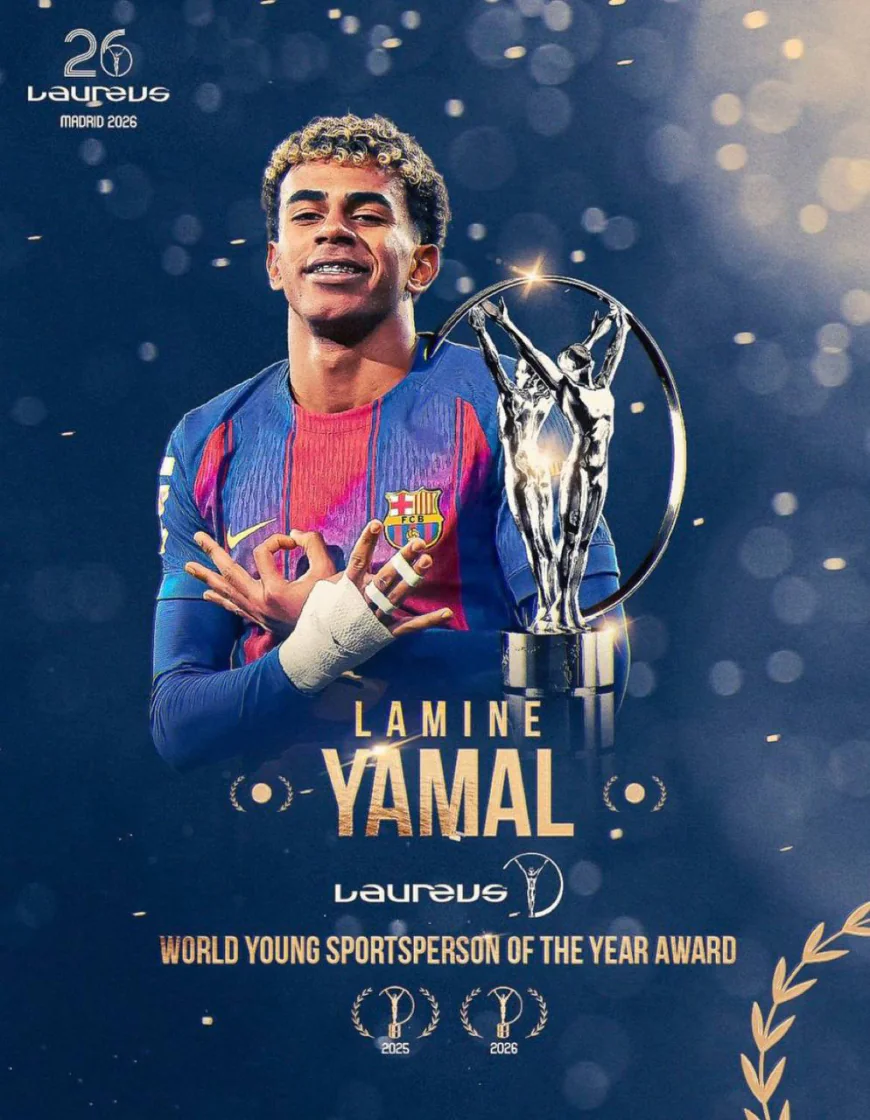
Fast forward 364 days. April 20, 2026. Same building, same city, same award show. Laureus added a new category for 2026: Young Sportsperson of the Year. It is for athletes under 21. The Academy said they created it because teenagers are now deciding major events across sport, from tennis to athletics to football, and Breakthrough alone was not enough to capture it. They had four nominees: Yamal, tennis player Mirra Andreeva, skateboarder Arisa Trew, and sprinter Quincy Wilson. They picked Yamal again. He was 18 years and 9 months old. That made him the youngest athlete to win two Laureus awards, ever.
The case for the second one was built on what happened after he won the first. Barcelona won a domestic treble in 2024-25. La Liga, Copa del Rey, and Supercopa de España. Yamal was MVP of the Supercopa final against Real Madrid in Riyadh. He scored one and assisted one in a 3-1 win. He finished the La Liga season with 9 goals and 14 assists. The 14 assists are the most by a teenager in a single La Liga season since the league started tracking data. UEFA named him Champions League Young Player of the Season after Barcelona made the semifinals. He scored against PSG in the quarterfinal and set up two against Bayern in the group stage. He was voted into the La Liga Team of the Season and named La Liga Best U23 Player. So the 2026 award was not for potential. It was for a year where he was the decisive player in three trophies and the most productive teenage winger Europe has seen in decades.
Sebastian Coe is the Laureus chairman. He was asked after the 2026 gala if the Young Sportsperson category was made for Yamal. He said no, but his next line was telling: “His body of work from 2024 to 2026 made him the clear first recipient. The award is for influence. His influence is that 10-year-olds now play as left-footed right wingers because of him, and senior coaches now change their team to stop him.” That is the standard Laureus uses. The Academy does not care how old you are. They care if you changed the outcome of events that matter. Michael Johnson has said he does not vote for promise. Nadia Comăneci has said she votes for “moments that would have happened with or without age, but happened earlier because of the athlete.” Yamal gave them those moments twice.
It is worth putting the two wins in context because footballers do not collect Laureus awards. Lionel Messi won Sportsman of the Year in 2020 and 2023, at 32 and 35. Cristiano Ronaldo has never won one. Kylian Mbappé was 24 when he got his first nomination and did not win. Jude Bellingham won Breakthrough in 2024 at 20. Yamal won Breakthrough at 17 and Young Sportsperson at 18. He is the only footballer with two Laureus awards before turning 19. He is the only athlete in any sport with two before turning 19. There is no prize money. The trophy is a Cartier statuette. The real prize is the vote. It means 69 people who won Olympic gold medals, World Cups, and world titles looked at a kid and decided he had already met their standard.
What's Your Reaction?
 Like
0
Like
0
 Dislike
0
Dislike
0
 Love
0
Love
0
 Funny
0
Funny
0
 Wow
0
Wow
0
 Sad
0
Sad
0
 Angry
0
Angry
0

A facilitator in the Ghana Education Service










Comments (0)