

Bosch’s First Annual Loss Since the Financial Crisis
Germany’s industrial giant Bosch posts its first annual loss since the financial crisis, exposing deeper structural pressures in the global economy.
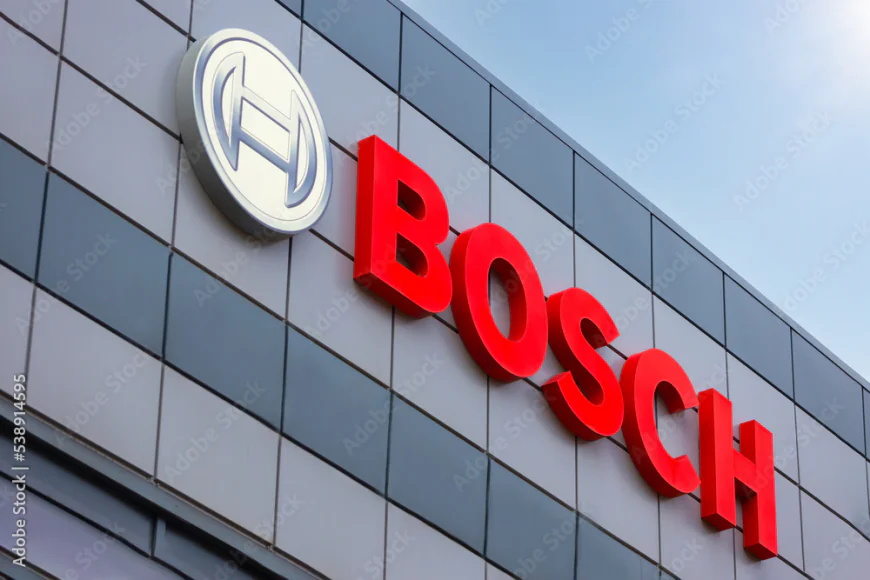
Robert Bosch GmbH is one of the world’s largest engineering and technology companies, headquartered in Germany.
It operates across four main areas: mobility (especially automotive components), industrial technology, consumer goods (such as home appliances), and energy/building solutions.
Bosch is particularly known for supplying parts and systems to the global automotive industry, making it a key player in manufacturing and industrial production worldwide.
The announcement that Robert Bosch GmbH has recorded its first annual loss since the 2008–09 financial crisis marks a significant moment not only for the company, but for Germany’s broader industrial economy.
While the headline figure reflects a sharp financial reversal, the underlying causes point to deeper structural pressures that have been building over several years.
Events Leading Up to the Loss
The financial decline did not emerge abruptly, but rather developed through a gradual erosion of profitability within a challenging global environment.
In 2024, according to Reuters, Bosch reported a substantial drop in operating profit to approximately €3.2 billion, representing a decline of nearly one-third compared to the previous year. Profit margins also weakened significantly, falling to around 3.5%, well below the company’s long-term target of 7%.
By 2025, these pressures intensified. Although revenues remained relatively stable at roughly €91 billion, profitability continued to deteriorate, with margins slipping further to below 2%.
This divergence between revenue stability and declining profit highlights a fundamental issue: the problem was not a collapse in demand, but the increasing cost of maintaining operations in a rapidly changing industrial landscape.
A combination of structural factors contributed to this trajectory. Weak global demand, particularly across European markets, constrained growth opportunities.
At the same time, competition intensified, especially from emerging manufacturers in China, placing downward pressure on prices. Rising input costs and geopolitical trade frictions further complicated the operating environment, increasing uncertainty and reducing efficiency.
Crucially, Bosch continued to invest heavily in future technologies, committing approximately €12 billion annually to research, development, and capital expenditure. While strategically necessary, these investments placed additional strain on already weakening margins.
Alongside this, the company initiated large-scale restructuring plans, including significant job cuts, which introduced further short-term costs.
Taken together, these factors created a situation in which Bosch was pursuing long-term transformation while facing immediate financial constraints. By early 2026, the company had already signalled that it expected a difficult period ahead, with delayed profitability targets and continued cost pressures.
The Turning Point: Understanding the Financial Reversal
The culmination of these pressures resulted in Bosch reporting a net loss of approximately €400 million for 2025, a stark contrast to the €1.3 billion profit recorded the previous year.
This represents the company’s first annual loss since the global financial crisis, underscoring the severity of the current situation.
Importantly, this loss occurred despite relatively stable revenues, reinforcing the idea that rising costs, rather than declining sales, were the primary driver.
A significant factor was the scale of restructuring expenses, which totalled around €2.7 billion. These costs were associated with organisational changes and workforce reductions aimed at improving long-term efficiency.
In addition to restructuring, external pressures played a key role. Trade tensions and tariffs disrupted supply chains and increased operational costs, while currency fluctuations added further volatility.
The automotive sector, which remains central to Bosch’s business model, also experienced a slowdown, reducing demand and exacerbating existing challenges.
Despite these difficulties, Bosch’s underlying operating performance remained positive.
The company’s core operations remain viable, and the reported loss is heavily influenced by transitional and one-off factors rather than by a complete breakdown in business fundamentals.
Nevertheless, the financial results signal a deeper issue. The traditional industrial model on which Bosch has long relied is under increasing pressure, particularly as the company navigates the transition toward electrification, automation, and digital technologies.
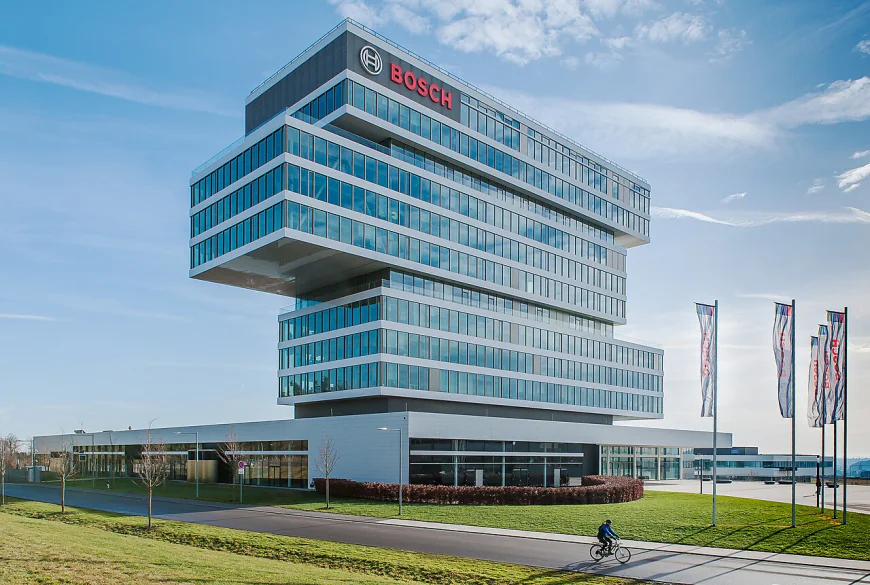 Renningen, Germany
Implications for the Economy
The significance of Bosch’s loss extends beyond the company itself, offering insight into the broader challenges facing Germany’s industrial economy.
As one of the country’s largest and most influential engineering firms, Bosch is deeply embedded within the manufacturing and automotive supply chain. Its financial performance, therefore, serves as a useful indicator of wider economic trends.
One key implication is the growing strain on Germany’s industrial model. The country’s economic strength has historically been rooted in high-value manufacturing and export-led growth, particularly within the automotive sector.
However, this model is increasingly challenged by global competition, technological disruption, and shifting demand patterns. Bosch’s difficulties reflect these broader structural changes, suggesting that traditional sources of economic strength are becoming less reliable.
At the same time, the company’s losses highlight the cost of industrial transformation. The transition toward electric vehicles, digital systems, and advanced manufacturing requires substantial investment, which in turn places pressure on short-term profitability.
Bosch’s continued commitment to high levels of research and development spending illustrates the scale of this challenge. Firms must invest to remain competitive, yet these investments can weaken financial performance in the near term.
The decline in profit margins also points to wider issues within the automotive supply industry. Reduced pricing power, rising competition, and structural overcapacity are contributing to a more challenging operating environment. If these trends persist, the sector may experience consolidation, with smaller or less adaptable firms struggling to survive.
At a macroeconomic level, the implications are equally significant. A slowdown in industrial performance can lead to reduced business investment, weaker export growth, and slower overall economic expansion.
Given Germany’s central role within the European economy, these effects are likely to extend beyond national borders, influencing growth across the eurozone.
Final Thoughts
Bosch’s first annual loss in more than a decade represents more than a temporary financial setback. It reflects a broader process of structural adjustment within both the company and the global economy.
While short-term factors such as restructuring costs and external pressures have played a role, the underlying issue is the transformation of industrial systems in response to technological change and global competition.
In this context, the loss can be understood not simply as a sign of decline, but as an indication of the cost associated with adaptation. As Bosch and similar firms continue to navigate this transition, their experiences will play a critical role in shaping the future trajectory of Germany’s economy.
What's Your Reaction?
 Like
0
Like
0
 Dislike
0
Dislike
0
 Love
0
Love
0
 Funny
0
Funny
0
 Wow
0
Wow
0
 Sad
0
Sad
0
 Angry
0
Angry
0

I’m a freelance writer with a passion for business, lifestyle, and opinion pieces that explore culture, trends, and real-world insights. I bring a perspective that blends professional knowledge with cultural awareness, drawing on my experience in real estate and a keen interest in South Asian lifestyle and culture. I hold a Master’s in Popular Music Practice, and outside of writing, I enjoy playing the flute and reading about philosophy and psychology. I love crafting engaging, thought-provoking stories and am always excited to pitch fresh ideas or take on features that connect communities, trends, and the bigger picture.

















Comments (0)