

President Cites Basic Education Failures for Poor WASSCE Results at Doha Forum 2025
President John Dramani Mahama has announced a major shift in Ghana’s education policy, linking the recent decline in performance at the West African Senior School Certificate Examination (WASSCE) to long-standing weaknesses in basic education. Speaking at the Doha Forum 2025, he emphasized that the government will now prioritize early literacy and numeracy to strengthen the foundation of learning.

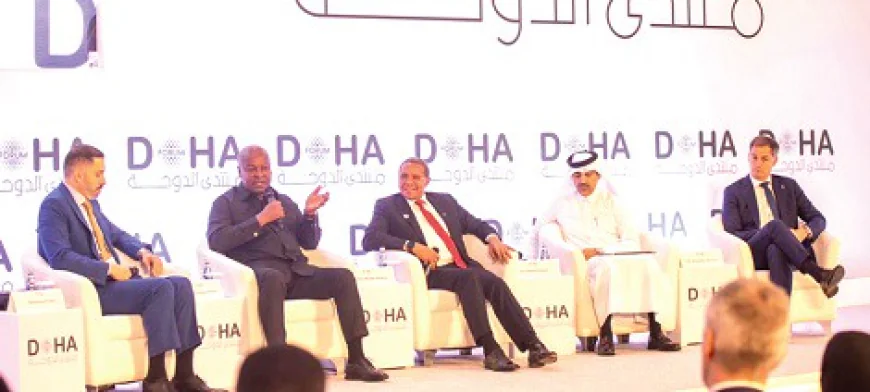

President John Dramani Mahama has announced a major shift in Ghana’s education policy, linking the recent decline in performance at the West African Senior School Certificate Examination (WASSCE) to long-standing weaknesses in basic education. Speaking at the Doha Forum 2025, he emphasized that the government will now prioritize early literacy and numeracy to strengthen the foundation of learning.
The President noted that neglect at the basic level has made progress at the secondary level difficult. He stressed the importance of mastering the “three Rs” — reading, writing, and arithmetic — as the bedrock of education. Weaknesses in mathematics, sentence construction, and writing skills were highlighted as recurring problems in WASSCE results.
Mahama pointed out that spending at the secondary level has grown disproportionately, weakening the foundation for pupils. He called for a more balanced distribution of resources to achieve better outcomes. Ghana’s education funding model, supported by a 2.5% VAT allocation to the Ghana Education Trust Fund (GETFund), has enabled the country to meet its 20% target for education financing.
Beyond foundational learning, the government plans to revamp technical, vocational, and educational training (TVET). Mahama argued that Ghana’s inherited system places too much emphasis on academic achievement rather than practical skills. Industry leaders, he said, require more middle-level technicians than graduates in business administration or the humanities.
With dwindling external funding for education, Mahama urged African nations to adopt domestic financing mechanisms. He cited Ghana’s VAT-based model as an example of how countries can sustainably fund education without relying heavily on global partners.
What's Your Reaction?
 Like
0
Like
0
 Dislike
0
Dislike
0
 Love
0
Love
0
 Funny
0
Funny
0
 Wow
0
Wow
0
 Sad
0
Sad
0
 Angry
0
Angry
0











Comments (0)